Food Cart License and Permission in Bangladesh: What You Actually Need
A practical guide to food cart permissions, startup costs, footpath risks, essential documents, daily sales maths, and food safety in Bangladesh.
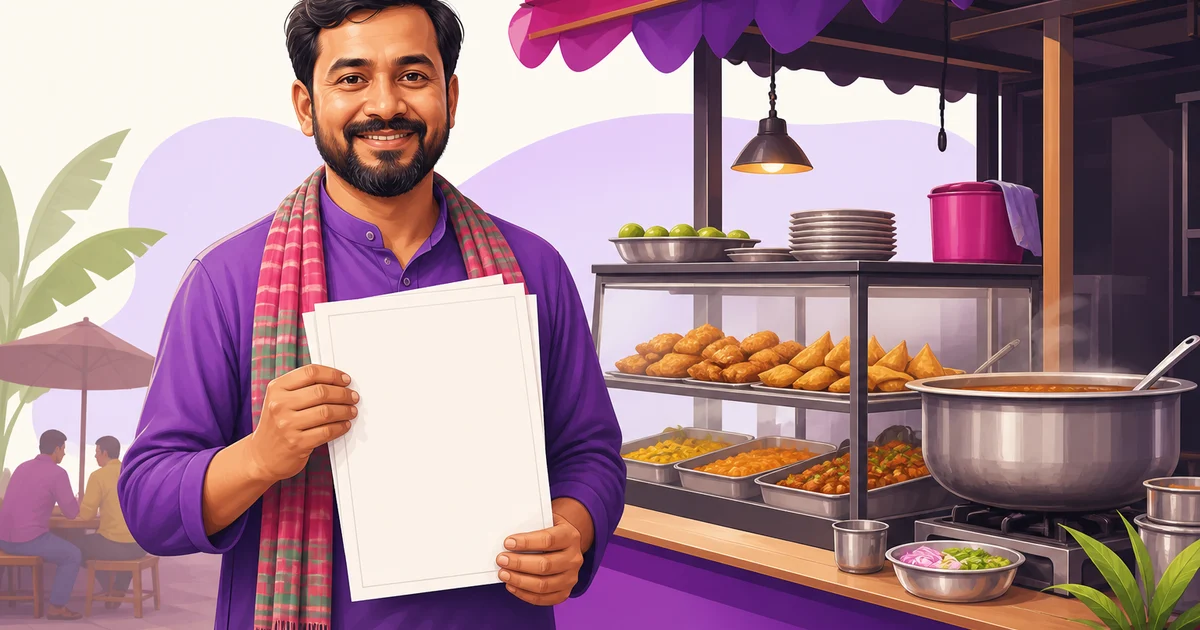
A food cart license in Bangladesh is not usually one simple certificate that gives you permission to trade anywhere. A trade licence identifies your business, while permission to occupy a road, footpath, market edge or private frontage is a separate issue. Food safety requirements also apply, but the process is clearer for a fixed shop or kitchen than for a cart that moves between locations.
This guide is for an owner-operator starting with limited capital. It explains the practical position without pretending that every ward follows the same process. Rules, fees and enforcement vary by city corporation, municipality, market and location. Confirm your plan with your own ward or zonal office before buying the cart. This is practical business information, not legal advice.
What a Food Cart License Actually Means in Bangladesh
Three different questions are often mixed together when people ask about a food cart licence:
- Is your business registered locally? This is normally addressed through a trade licence from the relevant city corporation or municipality.
- Are you allowed to use that particular space? A trade licence does not automatically grant the right to occupy a public footpath, road or traffic island.
- Does your food operation meet safety requirements? The Bangladesh Food Safety Authority, local authorities and other enforcement bodies can inspect food preparation, storage, water, cleanliness and handling.
A fixed cart on private land is easier to regularise than a cart that changes location every evening. If a shop owner, petrol station, office, university, hospital or market authority controls the land, ask for written permission. You may still need a trade licence and any food-related approval applicable to the premises, but you will at least have evidence that you are not occupying the site without the landholder's consent.
Start With the Ward Office Before Spending Money
Visit the city corporation ward or zonal office responsible for the location where you intend to operate. Outside a city corporation, contact the municipality or other relevant local authority. Take your NID, photographs, proposed business name, cart description and the exact address or location.
Ask direct questions:
- Can a trade licence be issued for this type of mobile or roadside food business?
- Must the licence use a fixed preparation or storage address?
- Is a landlord's consent letter or private-land permission required?
- Does this location need separate market, pavement or vending permission?
- Which food-business category and official fee schedule apply?
- Which documents must be displayed or carried on the cart?
Trade licences are generally address-based. That creates a practical difficulty for a fully mobile cart. Some operators use a fixed kitchen, home preparation address or private parking location as the business address, but you should not assume this will be accepted. Explain honestly where ingredients are stored, where food is prepared and where the cart will sell.
Request an application receipt, challan or other official payment record. Pay only through the stated official process and keep the receipt. An unofficial collection does not create a legal right to use a footpath and should never be treated as permission. For a fuller explanation, read the restaurant trade licence guide for Bangladesh.
BFSA Expectations for a Cart Versus a Fixed Premises
Food sold from a cart is still food offered to the public. You remain responsible for safe water, clean utensils, protected ingredients, correct storage temperatures, waste disposal and hygienic handling. Being small or mobile does not remove those responsibilities.
The licensing position can be less straightforward when the cart has no permanent premises. A moving cart is often dealt with mainly through city-corporation rules, location enforcement and local administrative practice. Once you operate from a fixed takeaway counter, shop, commercial kitchen or regular preparation premises, the applicable BFSA food-business licensing or registration process becomes much clearer and should be addressed.
Contact the relevant BFSA district or metropolitan office and describe the operation accurately. Ask whether your preparation site, selling point or both require a food licence or registration under the current category. Requirements can change, so do not rely only on another vendor's experience. The BFSA food licence guide covers the fixed-premises process in more detail.
Inspectors may focus on conditions rather than the size of the business. Keep raw and cooked food separate. Use covered, food-safe containers. Provide handwashing water and soap. Protect food from dust, flies and vehicle smoke. Do not leave sauces, meat, dairy or cooked rice at unsafe ambient temperatures for long periods. A practical food safety and hygiene checklist can help you build a daily routine.
What Footpath Trading Involves in Practice
A busy footpath looks attractive because there is no shop rent, but it carries serious uncertainty. Public footpaths are meant for pedestrian movement. Roadsides can involve traffic, drainage, utility access and public-safety restrictions. A trade licence alone normally does not reserve a patch of pavement for your cart.
Local enforcement can vary from one road to another. A cart may operate for weeks and then be moved because of a clearance drive, complaint, roadwork, traffic problem or event. Verbal tolerance is not the same as written permission. Do not build your entire investment around a site that can disappear overnight.
For a beginner, a private frontage with written consent is often safer. Possible sites include an office compound, workshop yard, community market, private university area or the forecourt of another business. Confirm access hours, electricity, water, waste removal, security and the monthly or daily site charge in writing. Also confirm whether the landholder actually has authority to offer the space.
What You Actually Need to Buy
Prices differ by city, fabrication quality and whether equipment is new or used. Market rates also move with steel, LPG and transport costs. Use these as planning ranges, then collect at least three local quotations.
- Basic fabricated cart: approximately ৳25,000 to ৳80,000, depending on stainless-steel work, wheels, glass enclosure, storage and weather protection.
- Burner, stove or griddle: around ৳4,000 to ৳15,000.
- LPG setup: roughly ৳6,000 to ৳12,000 for the initial cylinder arrangement, regulator and hose, subject to supplier terms and current prices.
- Pots, knives, boards, tongs and containers: about ৳5,000 to ৳15,000.
- Water, handwashing and cooling equipment: approximately ৳3,000 to ৳12,000.
- Lighting, canopy, bin and fire extinguisher: around ৳3,000 to ৳10,000.
- Opening stock and packaging: approximately ৳5,000 to ৳15,000 for a deliberately small menu.
- Applications, signs and document preparation: budget around ৳2,000 to ৳10,000, but verify official fees and insist on receipts.
A practical starting budget may therefore fall between roughly ৳48,000 and ৳154,000. A second-hand cart can reduce this, while refrigeration, a generator, custom branding or a large deposit for private space can increase it substantially. Keep working capital outside this equipment budget. You still need cash for ingredients, gas, transport, packaging and slow sales during the first few weeks.
Daily Sales and Margin Maths You Can Redo
Do not choose a menu because an item looks popular online. Start with the selling price, expected order count and cost per portion. Suppose your average bill is ৳130 and you serve 45 orders:
- Sales: 45 × ৳130 = ৳5,850
- Food and packaging at 45 percent: about ৳2,630
- Site charge and transport: assume ৳800
- Gas, water and cleaning: assume ৳250
- Waste, samples and small shortages: assume ৳200
- Remaining contribution: approximately ৳1,970
That ৳1,970 is not pure profit. It still needs to cover your own labour, cart depreciation, repairs, licence renewals, phone costs and bad-weather days.
Now test a slower day with 25 orders at the same ৳130 average. Sales fall to ৳3,250. If food and packaging cost about ৳1,460, while site, transport, utilities and waste total roughly ৳1,200, only about ৳590 remains before paying for your time and equipment. This is why footfall and repeat customers matter more than a fashionable cart design.
Redo the calculation using your own supplier prices. Weigh each serving. Include sauce, oil, tissue, cup, lid, bag and wastage. If you cannot calculate the cost of one complete order, you do not yet know whether the selling price works.
Where First-Time Cart Owners Lose Money
- Too many menu items: Slow-moving ingredients spoil, while service becomes harder for one person.
- Choosing a site after buying the cart: The cart may not fit the approved space or the location may not permit vending.
- Ignoring rain and heat: Bad weather cuts footfall and increases food-safety risk.
- Underpricing: Owners count meat and bread but forget oil, gas, packaging, sauce and waste.
- Buying stock without daily records: Small cash purchases can quietly consume the margin.
- Mixing household and business cash: You cannot tell whether the cart is earning or merely circulating money.
- Depending on one verbal arrangement: A site can be lost when a landlord, manager or enforcement situation changes.
For a one-person cart, three to six well-costed items are usually easier to control than a restaurant-sized menu. Buy perishables in smaller quantities until demand becomes predictable.
Documents Worth Keeping on the Cart
The exact mandatory documents depend on your authority and operating model. Keep clear copies in a waterproof folder and digital copies on your phone:
- Current trade licence and official payment receipt, if issued
- Your NID copy and emergency contact details
- Written permission or no-objection letter from the private landholder
- Rental or site-use agreement, where applicable
- Applicable BFSA licence or registration documents for a fixed premises
- Supplier invoices for meat, dairy, oil and other important ingredients
- LPG purchase records and any available cylinder or safety documentation
- Fire-extinguisher service record or inspection tag
- A short cleaning, temperature and opening-stock checklist
Do not display your original NID where it can be lost. Keep the original available securely if an authorised official needs to verify the copy.
Keep Record-Keeping Proportionate
A notebook is enough at the beginning if you record opening stock, purchases, sales, waste and cash every day. Once order volume makes manual totals unreliable, a lightweight phone-based POS can help with bills and daily sales totals.
Rosuii can run in a browser on a phone, tablet or laptop. Its free plan can handle basic POS billing and reports, while inventory tools are available when a paid plan becomes worthwhile. A single cart should adopt software only if it saves time or reduces missing cash, not because it needs restaurant-level complexity.
A Sensible Order of Action
- Choose a small menu and calculate the full cost per order.
- Shortlist private or locally permitted sites before fabricating the cart.
- Visit the responsible ward, zonal or municipal office with the exact operating details.
- Confirm trade-licence, site-permission and food-licensing expectations.
- Collect written quotations for the cart and essential equipment.
- Run a short sales test where permission allows before adding expensive equipment.
- Keep every official receipt, approval and supplier invoice.
- Review sales, waste and cash at the end of each day.
The safest plan is not the one with the biggest cart. It is the one with a permitted location, a short profitable menu, clean handling and enough cash to survive slow days.
If your order volume grows beyond a notebook, you can start with Rosuii for phone-based billing and clear daily sales records.
Last updated:
Frequently asked questions
Do I need a trade licence for a food cart in Bangladesh?
Does a trade licence allow me to sell on any footpath?
Does a moving food cart need a BFSA food licence?
How much money should I budget to start a food cart?
Which documents should I carry on the cart?
Run your restaurant on Rosuii
POS, menu, inventory, payroll and more — built for Bangladeshi restaurants.
Start free