All in One Restaurant Management Software: Why One Platform Wins
All-in-one restaurant management software puts POS, inventory, payroll, online ordering and reports on one platform instead of three apps that barely talk. Here is why one integrated system cuts cost, data errors and daily headaches for restaurants in Bangladesh.
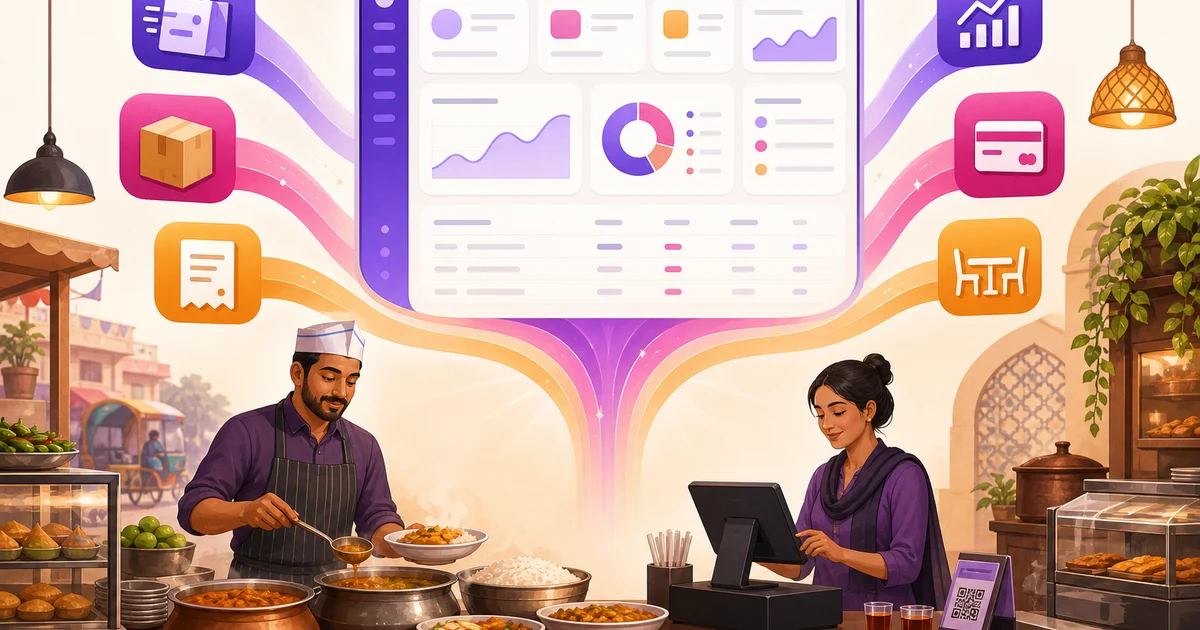
All in one restaurant management software puts your POS, inventory, payroll, customer loyalty, online ordering and reports on a single platform, instead of stitching together a separate app for each. The case for it is simple: one system costs less than three subscriptions, keeps your data in one place so the numbers actually agree, and removes the manual copying between tools where most errors creep in. This guide makes that case in detail, and shows where Rosuii fits as an example that replaces roughly three apps for a typical Bangladeshi restaurant.
If you are still deciding what restaurant software even covers, start with our guide to restaurant management software. This page assumes you know the modules and focuses on one question: one integrated platform, or a stack of separate apps?
Why all in one restaurant management software matters
Picture a restaurant where billing, stock, salaries and online orders each live in a different tool. None of them know about each other, so the owner spends every evening copying figures from one screen to the next just to see how the day went. An integrated platform removes that chore by holding every part in one place. The benefit is not a longer feature list; it is fewer places for the same number to go wrong and fewer hours spent making tools agree. The sections below break down where the savings come from.
The hidden cost of stitching apps together
Plenty of restaurants end up with a setup that grew by accident. A POS app for billing, a spreadsheet or a second app for stock, a notebook or a third app for staff and salaries, the foodpanda and Pathao dashboards for delivery, and maybe a separate page builder for online orders. Each was a reasonable choice on its own day. Together they create a tax you pay every single shift.
You pay for the same thing several times
Separate tools mean separate subscriptions, often billed in dollars with foreign-card charges, plus the setup time for each. Three or four small fees add up to more than one platform that does the lot, and you manage four logins, four bills and four support queues instead of one.
Your data never agrees
This is the real problem. When sales live in the POS, stock lives in a spreadsheet, and salaries live in a notebook, nothing reconciles. You cannot see true food cost because the system that knows your sales does not know your purchases. You cannot trust profit because expenses sit in a different place from revenue. Every report becomes a manual merge, and every merge is a chance to get it wrong.
Manual copying breeds errors
Disconnected tools force people to re-key the same figures: today's sales into the accounts sheet, a delivery order from the foodpanda dashboard into the POS, a new menu price into two places. Each transfer is a typo waiting to happen, and the mistakes surface at month-end when they are hardest to trace.
Nobody owns the full picture
With work scattered across apps, no single screen shows how the restaurant is really doing. The owner pieces it together from memory and screenshots. A second branch makes this worse, because now there are eight tools, not four.
What one integrated platform changes
An all-in-one platform fixes these at the root, because the modules share one database. Enter a sale once and it flows everywhere it is needed.
- One cost. A single monthly fee in taka covers POS, inventory, payroll, CRM, online ordering and reports, with no surprise foreign-card charges and one bill to track.
- One source of truth. Sales, stock, expenses and salaries sit together, so food cost, profit and a day close are calculated, not assembled by hand.
- Fewer errors. Nothing is copied between tools, so there is no re-keying to get wrong. An order entered at the counter updates stock, reports and the customer's history at once.
- One view. A single dashboard shows the whole business, and across branches when you grow, without collecting separate books.
- One login and one support line. Staff learn one system, and when something needs help, there is one place to ask.
This is also the difference between a tool that fights you and one that helps, the test we apply throughout our roundup of the best restaurant management software in Bangladesh.
What "all-in-one" should actually include
The phrase gets stretched, so check that a platform genuinely covers the work rather than just bundling a POS with a couple of add-ons. A real all-in-one restaurant platform should handle:
- POS for dine-in, takeaway and delivery, with tables, discounts, and VAT and service charge built in.
- Kitchen and customer displays so orders reach the line without paper.
- Menu management with variations, add-ons and combos, in Bangla and English.
- Inventory and purchasing, including suppliers, purchase orders and wastage.
- Customers and loyalty, with coupons and a points scheme tied to phone numbers.
- Staff and payroll, with shifts, salaries and role-based permissions.
- Your own online ordering page, so direct orders do not all go through a commission marketplace.
- Reporting, from item sales to profit-and-loss and a day-close or Z-report.
If a product covers only the first two or three and points you to other apps for the rest, it is a POS, not an all-in-one platform.
Rosuii: one platform replacing about three apps
Rosuii is built as an all-in-one platform, and for a typical Bangladeshi restaurant it stands in for roughly three separate tools at once: a POS, an inventory and accounting setup, and an online ordering or delivery page. Here is how that maps.
| What you might use separately | What Rosuii covers in one place |
|---|---|
| A POS or billing app | POS for dine-in, takeaway and delivery, with kitchen and customer displays |
| A spreadsheet or stock app, plus an accounts book | Inventory and purchasing, expenses, payroll, and reports including profit-and-loss |
| A page builder or marketplace-only setup for online orders | Your own branded online ordering storefront, with marketplace presets when you want them |
Because these share one database, an order at the counter updates your sales, stock, customer loyalty and day total together. Each restaurant gets its own isolated database and a branded subdomain, so your data stays separate and yours. Pricing is in taka, the interface is fully bilingual, and payments use real bKash and Nagad alongside cash and cash on delivery (card is a placeholder). It runs in the browser on hardware you already own, and it does not fall over when the line drops: the POS caches your menu on the device and keeps taking orders during an outage, queuing each one locally and syncing it automatically when the connection returns. Online-payment confirmation and live multi-device sync still need a connection, so it is not a full offline system, but a dropped line no longer stops order-taking. See everything it includes on the features page.
When separate apps still make sense
An all-in-one platform is not always the answer, and it is fair to say so. A tea stall that only ever needs to ring up cash sales does not need inventory or payroll, and a free single-purpose POS may be enough. A restaurant with a deeply specialised need, like complex commercial accounting beyond expenses and payroll, may pair a platform with a dedicated accounting tool. The point is to choose deliberately. Reach for separate apps when you have a specific reason, not by accident because the setup grew one tool at a time.
How to compare the cost
Do the maths before you decide. Add up what you pay now: every subscription, the foreign-card markups, and an honest estimate of the hours staff spend copying figures between tools and reconciling at month-end. Then compare that total against one platform. For most restaurants in Bangladesh, an all-in-one plan in taka comes in lower than the stack it replaces, before you even count the errors it prevents. Rosuii is free to start, then ৳500 to ৳2,500 a month with no setup fee; weigh the plans against your current spend on the pricing page.
Ready to replace the stack with one platform? Create your free Rosuii account, set up your POS, inventory and online ordering, and run your whole restaurant from one screen.
Last updated:
Frequently asked questions
What is all-in-one restaurant management software?
Why is an all-in-one platform better than separate restaurant apps?
How many apps does Rosuii replace?
Does all-in-one restaurant software still work for a small restaurant?
Is an all-in-one platform more expensive than free single apps?
Run your restaurant on Rosuii
POS, menu, inventory, payroll and more — built for Bangladeshi restaurants.
Start free