Part Time Food Business in Bangladesh: Earn Without Quitting Your Job
A candid guide to running food sales around a job or studies, with workable formats, staffing choices, sample calculations, risks, and full-time signals.
A part time food business can produce extra income while you keep a job or continue studying, but food is not an easy side hustle. Ingredients expire, customers expect consistent timing, and preparation often starts hours before selling. If you can trade only during evenings or weekends, you need a format designed around those limits rather than a smaller version of a full-time restaurant.
This guide covers formats that can survive restricted hours, advance preparation, backup staffing, realistic earning limits, and the evidence you should collect before considering full-time trading. It does not promise income. Your result will depend on location, demand, food cost, waste, pricing, weather, competition, and how reliably you can operate.
Why a part time food business is harder than it sounds
Customers see the two or three hours when you sell. They do not see shopping, washing, cutting, cooking, packing, transport, cleaning, bookkeeping, and replying to orders. An evening cart open from 6 pm to 10 pm can still require preparation from the afternoon. A home tiffin service may need someone to buy ingredients and cook while you are at work.
Food also punishes irregularity. If customers find you closed without notice twice, many will stop checking. Unsold clothing can remain on a shelf, but unsold biryani, snacks, sauces, or dairy-based desserts may become waste. Part-time trading works best when the menu is short, the schedule is fixed, and another responsible person can cover essential hours.
Part time food business formats that fit limited hours
1. Evening cart or takeaway counter
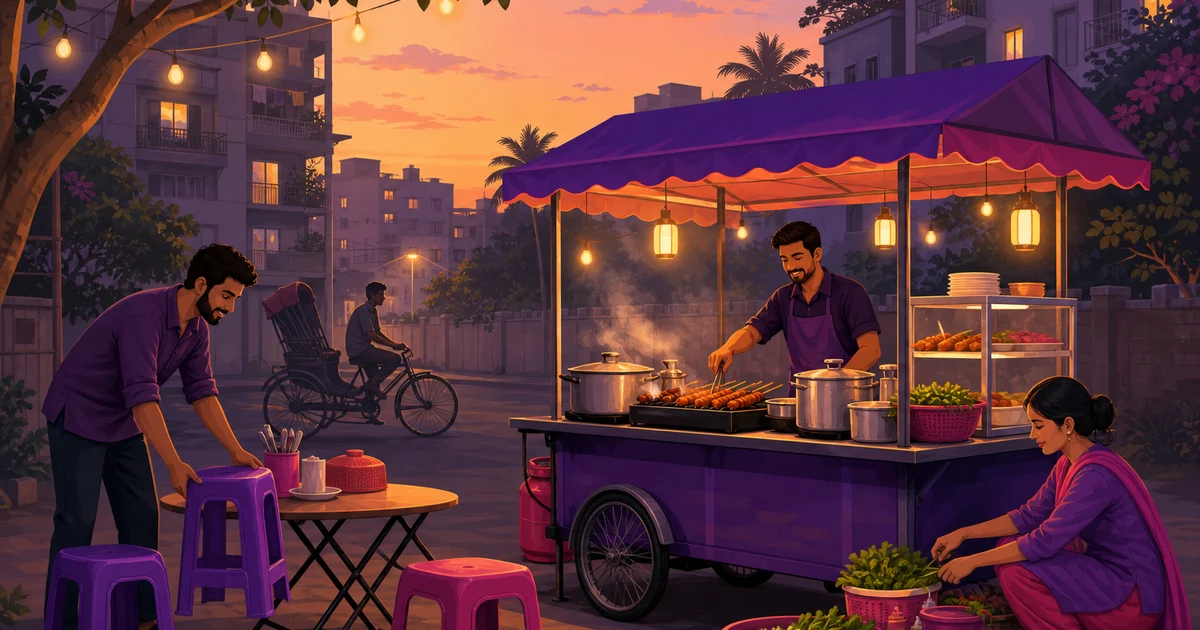
An evening operation suits areas where demand rises after office or class hours. Possible locations include residential gates, university areas, transport points, and office districts. Choose products that can be portioned quickly, such as rolls, grilled snacks, fuchka, sandwiches, noodles, tea, or a small rice-meal selection.
The main risk is location. Heavy foot traffic does not automatically mean buyers, and permission from the property owner, market committee, or local authority may be necessary. Test a location for several evenings before investing heavily. For a deeper look at operating after dark, read this guide to a night food business in Bangladesh.
2. Weekend-only stall
A Friday and Saturday stall can fit an office schedule. Community fairs, apartment events, school programmes, markets, and pop-ups give access to concentrated demand without a daily commitment. Keep the display attractive and the menu limited enough to serve a queue.
Demand can be uneven. Rain, a competing event, a poor stall position, or low attendance can leave you with stock. Ask organisers about expected visitors, electricity, water, waste disposal, stall fees, and whether similar sellers will be present. Never prepare solely from an organiser's optimistic attendance claim.
3. Home tiffin with fixed subscribers
Subscriptions are often more manageable than accepting random orders every day. A fixed group of office workers, students, or nearby families can order for selected days each week. An order cutoff lets you buy and cook against known quantities, which reduces waste.
This model still needs daytime labour and reliable delivery. A family member, cook, or delivery partner may have to work while you are at your job. Start with one delivery window and a small service area. The guide to selling food online from home in Bangladesh explains ordering and home-operation considerations in more detail.
4. Festival and season-only selling
Ramadan snacks, winter pitha, Eid gift boxes, mango products, and event catering can concentrate sales into a defined season. Pre-orders are safer than producing large quantities and hoping they sell. Publish the menu, take orders by a clear deadline, and set collection or delivery slots.
Seasonal demand is brief and competitive. Ingredient prices may rise close to festivals, while late deliveries can damage trust quickly. If winter products interest you, see this practical guide to a pitha business in Bangladesh.
Build the operation around your available hours
Write down every hour you can genuinely give the business. Include commuting and recovery time. Someone who reaches home at 7 pm should not advertise a 6 pm opening unless another person can start without them.
A workable preparation system may include:
- One short menu: Begin with a few items sharing ingredients. Too many dishes create slow service and leftover stock.
- Order cutoffs: Stop next-day tiffin or weekend pre-orders at a stated time so purchasing is based on confirmed demand.
- Portioning: Measure ingredients and packaging before service. This helps control cost and serving size.
- Batch limits: Prepare a first batch, then replenish only if demand justifies it. Selling out slightly early can be safer than discarding a large quantity.
- Food safety: Keep raw and cooked food separate, chill prepared food promptly, use clean covered containers, and discard anything that may be unsafe. Confirm applicable requirements with the Bangladesh Food Safety Authority and your local authority.
- Closing routine: Count cash and digital receipts, record waste, clean equipment, and prepare a shopping list before ending the day.
Advance preparation does not mean cooking everything days early. Decide what can safely be washed, measured, marinated, or packed in advance and what must be cooked fresh. Avoid repeatedly cooling and reheating food simply to fit your schedule.
Who covers the hours when you cannot be there?
This question can decide whether the business survives. A spouse, sibling, partner, cook, or paid helper may handle purchasing, preparation, customer messages, or delivery. Do not rely on a vague promise that someone will help when free.
Assign written responsibilities. State who holds cash, approves purchases, records credit sales, checks stock, and decides whether questionable food must be discarded. If you pay a helper, an illustrative shift cost might move around ৳400-৳800, depending on location, hours, skill, and market conditions. Verify current local rates rather than treating that range as a standard.
Also plan for absence. If you become ill during a busy weekend and nobody knows the recipes, supplier numbers, or order list, you may need to cancel. It is better to have a cancellation message and refund process ready than to accept orders you cannot fulfil.
A step-by-step part-time income example
All taka figures below are illustrative ranges that move with the market. Replace them with your supplier quotes, selling prices, actual order count, and local labour or pitch costs.
Suppose an evening stall can serve 18-24 orders per night. The average selling value is around ৳150-৳180 per order, while ingredients, packaging, and other order-linked costs total around ৳80-৳110 per order.
- Calculate sales: The lower example is 18 orders multiplied by ৳150. The upper example is 24 orders multiplied by ৳180. That gives estimated nightly sales of ৳2,700-৳4,320.
- Calculate contribution per order: Subtract the higher variable cost from the lower selling value for the cautious end, then subtract the lower variable cost from the higher selling value for the stronger end. The calculation is ৳150 minus ৳110 through to ৳180 minus ৳80, producing ৳40-৳100 per order.
- Calculate nightly contribution: Multiply 18 orders by ৳40 at the cautious end and 24 orders by ৳100 at the stronger end. That produces ৳720-৳2,400 before nightly fixed costs.
- Subtract nightly costs: If transport, pitch fees, fuel, and helper costs together are around ৳500-৳900, the nightly operating result could range from a ৳180 loss to a ৳1,900 surplus.
- Estimate a trading month: At 12-16 trading nights, the broad result could range from a loss of about ৳2,160-৳2,880 at the weak end to a surplus of around ৳22,800-৳30,400 at the stronger end.
This is not take-home income. It excludes the value of your own time, equipment replacement, licences, tax obligations, spoilage outside service, and money retained for the next stock purchase. A slow month can sit near the loss end. A busy month cannot be assumed to repeat.
The honest income ceiling of part-time trading
Your available hours create a physical ceiling. If you can trade for three hours and serve about eight orders per hour, capacity is roughly 24 orders unless someone else prepares or serves. Marketing cannot remove that limit. Raising prices may improve contribution, but only if customers still see value.
Tiffin subscriptions can increase predictable volume, while festival orders can produce short peaks. Both require more production and delivery capacity. Once hired labour does most of the work, the business may continue during your job hours, but labour cost and supervision reduce the amount left for you.
Judge performance by operating profit and cash flow, not social-media reach or gross sales. Revenue that passes through your account is not the same as earnings.
What can go wrong
- Bad location: Plenty of people may pass without wanting your product or price point.
- Spoilage: Overproduction, poor storage, power cuts, or weak demand can turn stock into waste.
- Slow month: Exams, rain, Ramadan schedule changes, holidays, or reduced household spending can cut orders.
- Illness with no backup: One unavailable owner can stop purchasing, preparation, service, and delivery at once.
- Inconsistent quality: Customers notice changing portions, recipes, packaging, and delivery times.
- Cash leakage: Unrecorded purchases, free items, personal withdrawals, and missing stock can erase a small margin.
Reduce these risks with small batches, pre-orders, a backup person, written recipes, separate business cash, and daily records. Before trading, confirm trade-licence, food-safety, location, landlord, and local-authority requirements for your exact setup.
Signals that the business may be ready for full time
Do not resign after one festival or one viral weekend. Look for evidence across at least several normal trading months:
- Sales remain repeatable outside festivals, payday weekends, and promotional discounts.
- Your records show positive operating profit after ingredients, packaging, labour, delivery, rent or pitch fees, waste, and equipment allowance.
- Regular customers reorder, and you are declining genuine demand because your current hours are too limited.
- Recipes, purchasing, hygiene, stock checks, and cash handling work even when you are not present for every step.
- You have reliable suppliers and at least one trained backup person.
- You hold a personal emergency fund covering roughly four to six months of household expenses.
- A cautious full-time forecast produces enough profit to replace your salary, not merely enough revenue to equal it.
Before leaving a job, test extended hours using annual leave, a holiday period, or temporary help. Compare the extra sales with the extra labour, waste, utilities, and delivery costs. More opening hours do not automatically mean better profit.
Keep records simple from the first sale
A notebook or spreadsheet is enough at the beginning if you use it every day. Record orders, sales, purchases, waste, cash, mobile payments, and closing stock. When manual tracking becomes difficult, a very small operator may use Rosuii on a phone for daily sales totals and a short stock list. Software can organise records, but it does not create demand, control food quality, or guarantee profit.
If your order volume is becoming difficult to track manually, register for Rosuii and test whether its phone-friendly POS and reporting fit your operation.
Last updated:
Frequently asked questions
Can I run a part time food business while working a full-time job?
Which part-time food format has the lowest spoilage risk?
How should I calculate profit from part-time food sales?
Do I need a trade licence for a small home or street food business in Bangladesh?
When is a part-time food business ready to become full time?
Run your restaurant on Rosuii
POS, menu, inventory, payroll and more — built for Bangladeshi restaurants.
Start free