Food Cart Business Plan Bangladesh: One-Page Model
A one-page plan that can be tested at the location before money is locked into a cart and equipment.
Last verified: 2026-08-28
A food cart business plan in Bangladesh should answer seven questions on one page: who buys, where they buy, what three to six items you sell, why the food is safe and convenient, what each order contributes, how many orders reach break-even and which permissions apply to the exact location.
SME Foundation's business-plan material covers marketing, production, people, sales forecasts, raw materials, risk and profit and loss. For a cart, compress those sections into a testable operating model before buying equipment.
One-page plan
| Block | Decision | Evidence |
|---|---|---|
| Customer | Student, office worker, commuter or family | Short interviews |
| Location and time | Exact legal site and selling hours | Footfall counts |
| Menu | 3–6 fast items | Taste and travel test |
| Price | Contribution per item | Recipe and packaging cost |
| Capacity | Orders per peak hour | Timed trial |
| Permission | Local and food-safety path | Official authority |
| Cash | Setup plus working capital | Supplier quotations |
Test demand before building the cart
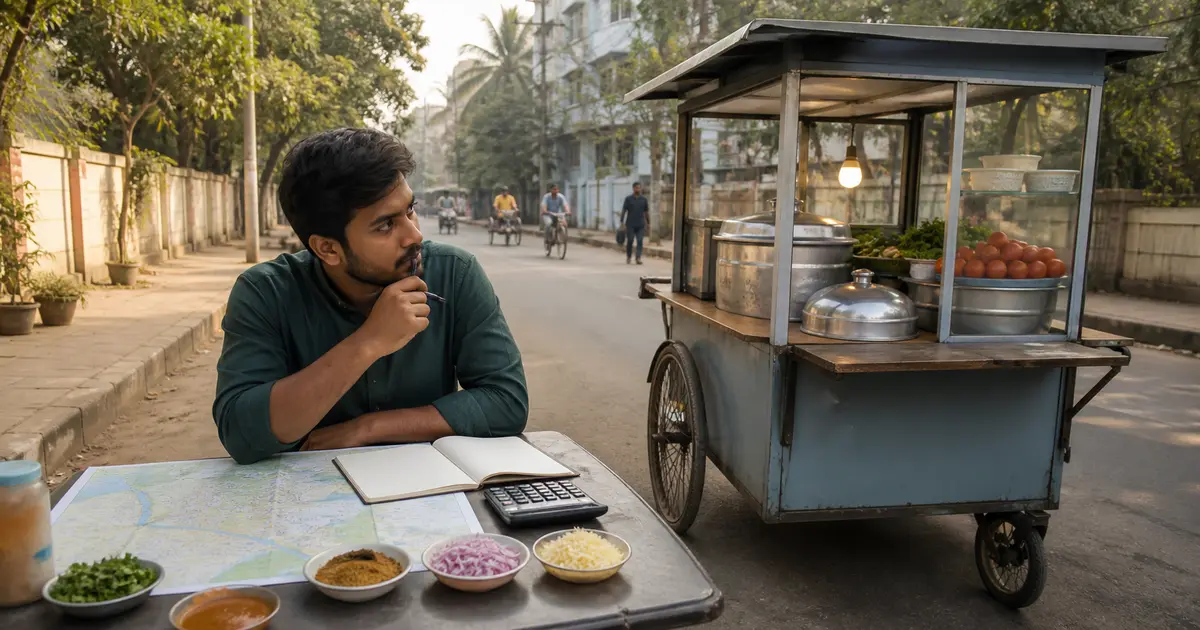
Count relevant footfall in 15-minute blocks on at least three comparable days. Note competitors, rain exposure, lighting, waste disposal, water access, traffic safety and whether vending is permitted.
Interview the intended customer with a specific menu and price. General questions such as would you buy street food produce weak evidence; ask which item, at what time and what they currently pay.
Design a small production model
Use few ingredients across several items, a short preparation flow and equipment that fits the site. Separate raw and ready-to-eat handling, protect food and provide handwashing and waste controls suitable for the operation.
Write batch size, holding rule, portion, preparation time and end-of-day disposal for every item. This converts food safety and margin from guesswork into tasks.
Financial model
Daily contribution = total sales minus ingredients, packaging, per-order channel charges and other variable selling costs. Daily operating result then subtracts the day's share of wages, site cost, fuel, transport, maintenance and other fixed or semi-fixed costs.
Prepare low, expected and high cases. A plan that works only at the high footfall case is not ready.
Permission and risk file
- Confirm local permission for the exact location
- Check food-business and safety obligations
- Document clean water and waste disposal
- Use suitable fire and fuel controls
- Plan for rain and heat
- Identify a backup supplier
- Keep an incident and complaint route
Four-week pilot
If permission allows, test with the smallest safe setup. Record hourly orders, item contribution, waste, stock-outs, queue time and repeat customers for four weeks.
Change one variable at a time. Move, expand or buy a permanent cart only after the evidence shows a repeatable peak and a positive contribution after all variable costs.
Evidence behind the one-page plan
Label quoted, measured, estimated and unknown inputs. This guide does not invent a universal taka budget; use current site-specific official and supplier evidence.
| Assumption | Evidence | Review trigger |
|---|---|---|
| Location demand | Timed observation/pilot | Site or schedule change |
| Menu volume | Test sales and capacity | Mix or item change |
| Price | Cost card and customer test | Cost/channel change |
| Fixed cost | Current quote/agreement | Renewal or scope change |
| Equipment | Menu-linked specification | Design or utility change |
| Permission | Actual local authority guidance | Activity/site change |
| Cash need | Timed low/base/high model | Payment or launch delay |
Location observation protocol
Observe the proposed service point across relevant dayparts and days. Record people flow, buying occasions, nearby offers, access, queue space, weather exposure, waste route, utility feasibility and any property or authority restriction. Foot traffic alone does not show willingness or permission to buy.
Run a lawful controlled pilot only after confirming the required approvals. Preserve sample size and conditions; do not turn one event's result into a guaranteed monthly forecast.
Capacity and service model
Map order, payment, preparation, cooking, packaging and handover steps. Time representative batches safely and identify the constraint. Use achievable units per service period in the financial model, not a theoretical appliance rating.
Design the menu to share ingredients and equipment without creating confusing choices. Record production, waste and stockouts during the pilot, then change one bottleneck at a time.
Cash-flow and downside test
Profit and cash are different. A plan can show period contribution while still lacking cash for deposits or supplier purchases. State the decision threshold and funding source before launch.
- Opening deposit and equipment timing
- Supplier payment terms
- Trading days actually available
- Low-volume and bad-weather case
- Ingredient and packaging cost movement
- Repair and downtime plan
- Refund and failed-payment treatment
- Owner compensation assumption
- Working-capital reserve and stop rule
Pilot decision review
Compare observed sales mix, realized price, variable cost, waste, service capacity, queue, customer feedback and operational exceptions with the plan. Correct data errors before changing the model. Do not hide an impractical volume target by assuming longer unsafe hours.
Decide proceed, revise, relocate or stop with an owner and evidence. Seek qualified legal, tax, food-safety and local authority guidance for the actual cart and site.
Maintain a risk register for authority permission, site access, weather, utilities, food safety, supplier interruption, equipment failure, cash security, staff absence and customer injury or complaint. Define preventive action, trigger, immediate response, owner and contact. Review insurance needs with a qualified provider and do not state that a generic policy covers the actual activity. Before each location change, repeat the jurisdiction, property, utility, customer-flow and waste-disposal checks rather than treating a movable cart as permission-free.
A food cart plan is useful only when every assumption has a test. Prove location demand, safe production and contribution before spending on appearance or a large menu.
Related guides
- Street Food Cart Business Bangladesh
- Food Cart Design and Cost
- Food Cart Daily Profit Calculation
- Compare restaurant management software
See this workflow in Rosuii: Track menu, sales and stock in Rosuii
Sources checked
Updated:
Frequently asked questions
What should a food cart business plan include?
How many menu items should a new cart have?
How do I test a location?
Is sales revenue the same as daily profit?
Where can I get a business-plan structure?
How much money is needed for a food cart in Bangladesh?
What should a food cart pilot test?
Is a one-page business plan enough?
When should a food cart plan be stopped or redesigned?
Run your restaurant on Rosuii
POS, menu, inventory, payroll and more — built for Bangladeshi restaurants.
Start free