How to Reduce Food Wastage in Your Restaurant
Every plate you throw away is money already spent. Here are practical, proven ways to reduce food wastage in your restaurant, from FIFO storage and portion control to forecasting and tracking waste reasons.
Wasted food is the cleanest profit you will ever find, because it is money you have already spent and can stop spending today. Most owners look at sales when they want to make more, but the kitchen bin is quietly eating margin every shift. Learn to reduce food wastage in your restaurant and you cut your food cost without changing a single price or buying a single new customer. This guide gives you the tactics that actually move the number, written for a busy kitchen in Bangladesh and tied to the inventory tools you already have.
None of this is about being stingy with portions or serving tired vegetables. It is about discipline: storing food so it gets used in time, cutting portions to spec, ordering closer to what you sell, and writing down what you throw away so the leaks stop hiding. Let us go through each one.
Store first-in, first-out (FIFO)
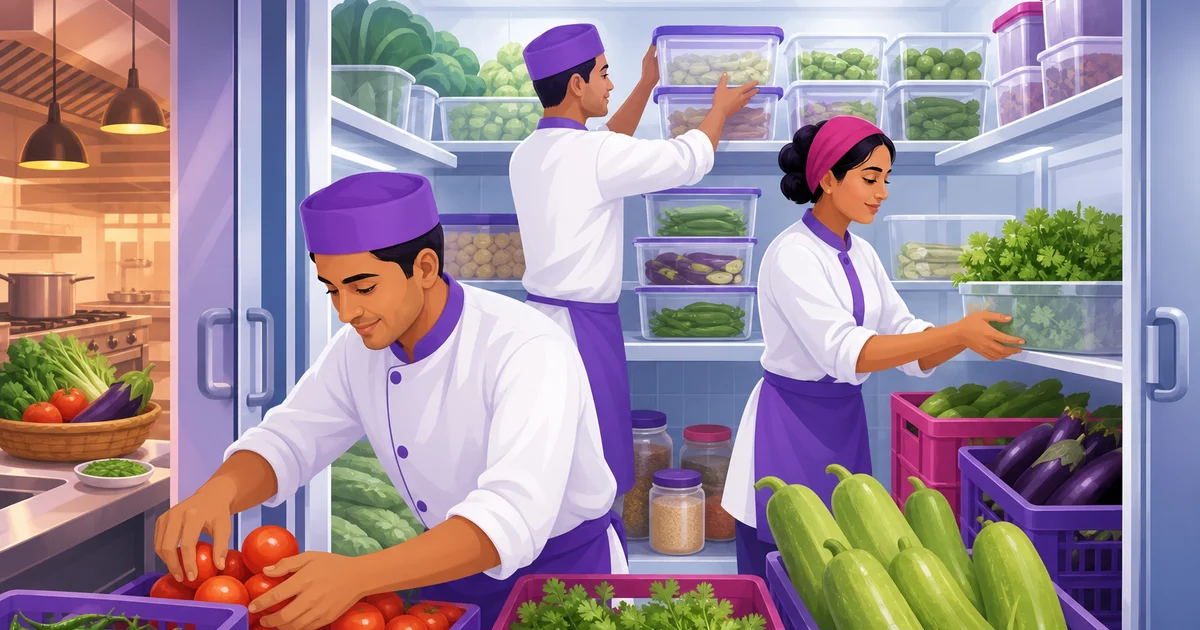
The single biggest source of spoilage is old stock sitting behind new stock until it goes bad. FIFO, first-in first-out, fixes this. When a delivery arrives, put the new stock behind or under what is already there, so staff always reach for the oldest first. Label received goods with the date so nobody has to guess.
This sounds obvious and gets ignored daily. A cook in a hurry grabs the front carton of milk or the top tray of chicken, and the older one slides further back until it expires. Set up your walk-in and dry store so the natural, lazy reach is also the correct one. Done right, FIFO alone can cut a chunk of spoilage with zero new spending, just a rule everyone follows.
Get storage and labelling right
FIFO only works if staff can tell what is old. Date every container and opened pack on the day it comes in or gets opened, so the oldest is obvious at a glance. Store food in airtight, clearly labelled boxes rather than open trays that dry out and pick up smells. Keep your fridge zones sensible: raw below cooked, fast-movers at the front, and nothing crammed so tight that air cannot move and cold spots form. A few cheap containers and a marker pen pay for themselves in food that does not spoil unseen at the back of a shelf.
Control portions to spec
Over-portioning is invisible waste. An extra spoon of gravy, a heavier hand on the rice, three prawns instead of two, none of it shows on a single plate, but across a thousand covers it is a real cost and a real swing in your food cost percentage. Worse, it makes dishes inconsistent, so customers never know what they will get.
Fix it with portion control. Use scoops, ladles and a scale so a portion is the same every time. Write portion sizes into a simple spec sheet so a new cook serves the same plate as your best one. The goal is not mean portions; it is consistent ones that match the price you set. When your portions are reliable, your costing becomes reliable too, which feeds straight into the work in our food cost percentage guide.
Forecast demand and order closer to it
Over-ordering is the other half of the spoilage problem. Buy more perishables than you sell and the surplus rots in the fridge. The cure is forecasting: use what actually sold last week to decide what to buy this week, instead of ordering the same amount out of habit.
You do not need a data scientist for this. Your sales history tells you that Thursdays and Fridays are busy and Mondays are slow, that biryani moves but a certain curry barely sells. Order perishables to match that rhythm. Rosuii's item-sales report shows you exactly what sold and when, so your buying follows demand rather than guesswork. Order tighter on slow days and you stop paying to throw food away.
Prep to par, not to the ceiling
The same logic applies inside the kitchen. Prepping huge batches of perishable items at the start of service feels efficient until half of it goes in the bin at closing. Prep to par instead: decide a sensible level of prepped stock for the shift, prep up to that, and top up only if you are busier than expected.
Par levels take the guesswork out of prep. A cook knows to make, say, two trays of cut vegetables and one batch of marinade, not as much as the table will hold. For batches you do prepare, recording them as a production in Rosuii keeps your stock honest, moving raw materials into finished goods so you can see how much prep you are really doing. Prepping to par is one of the fastest ways to reduce food wastage in your restaurant on perishable, made-fresh items.
Track wastage with a reason
Here is the habit that ties everything together. If you do not record what you throw away, you cannot manage it, because waste that is not written down simply disappears from your counts with no explanation. Log every wastage with a reason: spoilage, a cooking mistake, a dropped tray, expiry, a returned dish.
Rosuii lets you record wastages with exactly this reason field, and the reason is where the value sits. After a few weeks, patterns surface. Maybe vegetables spoil every Monday because of weekend over-ordering. Maybe one dish gets remade constantly because the portion is wrong. Maybe a fridge shelf keeps producing expired stock, a sign your FIFO is slipping. Each pattern points to a specific fix. Without the records, you are guessing; with them, you are solving named problems one at a time.
Use low-stock alerts to buy smarter
Waste and stock-outs are two sides of one coin, and low-stock alerts help with both. Set a minimum level on each item and let Rosuii flag when stock drops to it. That stops you over-buying "just in case" because you trust the system to warn you in time, and it stops the panic over-order that fills your fridge with food you will not sell. Buying closer to need is buying with less waste.
Low-stock alerts also catch a sneakier problem. If an item keeps hitting its minimum faster than your sales explain, something is off, over-portioning, spoilage you are not logging, or shrinkage. The alert is your early warning to go and look.
Repurpose trim and surplus
Not everything that does not sell as a dish is waste. Vegetable trimmings and bones make stock. Day-old bread becomes croutons or breadcrumbs. Ripe fruit goes into a juice or a dessert special. A surplus of a slow item can become tomorrow's staff meal instead of the bin. Build a short list of "what we do with leftovers" and your kitchen turns near-waste into either saleable items or saved cost.
The trick is to plan it, not to improvise at closing when everyone is tired. A simple rule like "trim goes in the stock pot, day-old bread becomes croutons" makes repurposing automatic.
A weekly routine to reduce food wastage in your restaurant
Pull it together into a rhythm you can actually keep:
- Daily: rotate stock FIFO, prep to par, log every wastage with its reason.
- Weekly: review your wastage records for patterns, and check your item-sales report to adjust next week's orders.
- Monthly: compare your food cost percentage with the previous month and see whether the changes are landing.
Most kitchens that take waste seriously trim a few points off food cost within a couple of months, which on ৳8,00,000 of monthly sales can mean ৳16,000 to ৳24,000 saved every month for the cost of better habits and a little record-keeping.
Where Rosuii helps
Rosuii gives you the two tools this whole effort runs on: wastage records with a reason, and low-stock alerts driven by minimum levels you set, both inside the same platform as your POS, menu and reports. Its item-sales report tells you what is actually selling so you order to demand, and productions keep your prep honest. It runs in the browser on hardware you already own, with inventory available on the Starter plan and above. See the full toolkit on our features page.
Ready to stop paying to throw food away? Create your free Rosuii account and start tracking your stock and wastage this week.
Last updated:
Frequently asked questions
What is the fastest way to reduce food wastage in a restaurant?
How does tracking wastage actually save money?
What is prepping to par?
Can Rosuii help control food waste?
How much can reducing food waste lower my food cost?
Run your restaurant on Rosuii
POS, menu, inventory, payroll and more — built for Bangladeshi restaurants.
Start free