Cloud POS vs Traditional POS: Which Suits Your Restaurant?
Cloud POS vs traditional POS is the biggest decision when you pick restaurant software. We compare them on cost, updates, remote access, data safety and internet, with an honest take for Bangladesh.
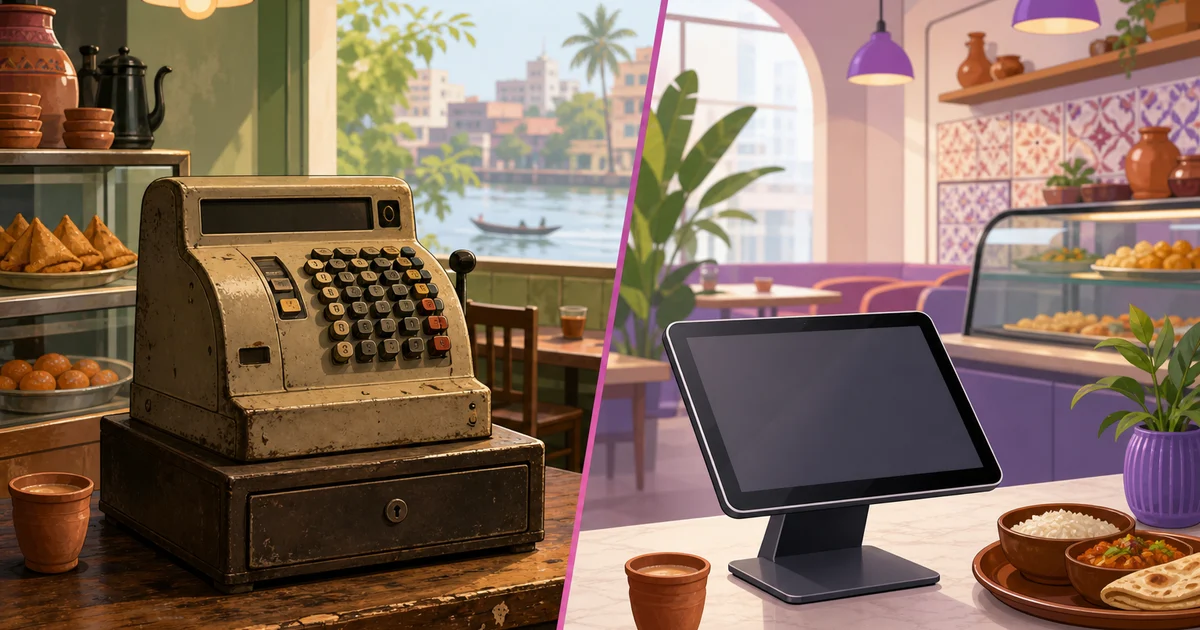
The first real choice when picking restaurant software is not the brand. It is cloud POS vs traditional POS, two different generations of technology that behave nothing alike. A traditional, or on-premise, POS is software installed on one machine behind your counter. A cloud POS runs through the internet, with your data on secure servers and the screen open in a browser. That single difference changes your cost, your data safety, how updates reach you, whether you can check sales from home, and whether you need internet to ring up an order.
This guide compares the two honestly on the things that actually matter, then gives a clear recommendation for restaurants in Bangladesh. We use Rosuii as the cloud example, described for exactly what it is: a cloud platform you open in a browser, with the trade-offs that come with that.
What each one actually is
A traditional POS is a program loaded onto a specific PC or terminal at the counter. Everything lives on that box: the software, your menu, your sales history. It does not need the internet to take an order, which is its headline strength. But it is tied to that one machine and the place it sits.
A cloud POS keeps the software and your data on servers reached over the internet. You log in from a browser on a tablet, phone or laptop, and any device with the login shows the same up-to-date information. It uses a connection to sync, but a good one does not freeze the moment the line drops. Rosuii is this second kind: a browser-based platform, installable as a PWA so it sits on your home screen like an app. It caches your menu in the browser and queues orders on the device during an outage, then syncs them automatically when the connection returns, so a dropped line no longer stops you ringing up an order.
Cloud POS vs traditional POS: the comparison
Here is how the two stack up on the points restaurant owners ask about most.
| Factor | Cloud POS | Traditional (on-premise) POS |
|---|---|---|
| Upfront cost | Low: a monthly fee, no expensive hardware | High: licence plus a dedicated terminal |
| Ongoing cost | Predictable monthly subscription | Paid upgrades, support contracts, repairs |
| Updates | Automatic, included | Manual, often charged |
| Remote access | Yes, from anywhere you log in | No, only at the machine |
| Data safety | Backed up off-site on servers | On one disk; lost if it fails |
| Multi-branch | A setting; one dashboard for all | Usually a fresh licence per location |
| Hardware | Tablet, phone or laptop you own | Proprietary terminal, locked in |
| Order-taking during an outage | Rosuii keeps taking orders offline and syncs when back online | Yes, fully standalone |
Cost
This is where most owners feel the difference first. A traditional POS asks for a large payment upfront: the licence and a dedicated terminal, often six figures in taka before you sell a single plate. A cloud POS turns that into a small monthly fee with no special hardware, since it runs on a device you already own. Rosuii, for example, is free to start and then runs ৳500 to ৳2,500 a month with no setup fee. For a new or small restaurant watching cash flow, spreading the cost is far easier than a big one-time outlay.
Updates and maintenance
With a traditional POS, new features and fixes arrive as updates you install yourself, and many vendors charge for major versions. With a cloud POS, improvements land automatically and are part of the subscription, so you are always on the current version without lifting a finger or paying again.
Remote access
A traditional POS shows your numbers only at the counter, on that one machine. A cloud POS lets you check today's sales from your phone at home, or watch a second branch while you stand in the first. For an owner who is not always on site, this alone often decides it.
Data safety
This is the quiet risk people forget until it bites. A traditional POS keeps your sales history on one hard disk. If that disk fails, is stolen, or the machine is damaged in a flood or fire, your records can vanish. A cloud POS stores your data on servers with off-site backups, so a broken device at the counter does not mean lost history. You just log in from another device and carry on.
Internet dependence (the honest trade-off)
A traditional POS is fully standalone, so it runs whether or not you have a line. A cloud POS leans on a connection to sync across devices and to confirm online payments like bKash and Nagad. The gap is narrower than it used to be. Rosuii caches your menu in the browser and queues orders on the device during an outage, then syncs them automatically when the line comes back, including marking them paid, so a dropped connection no longer stops you taking orders. What still needs a live line is real-time sync between devices and confirming an online wallet payment. The honest answer for Bangladesh is that this is manageable. Broadband is widely available, a cheap mobile-data SIM as backup covers the rare longer drops, and the on-device queue carries you through the short ones.
Which should a Bangladesh restaurant choose?
For most restaurants in Bangladesh, cloud POS is the better fit, and the reasons are practical. The low upfront cost suits the margins of a local cafe or a new outlet far better than a heavy licence. Automatic updates and off-site backups mean you are not relying on one PC that could die. Remote access lets an owner keep an eye on sales without living at the counter. And running on a tablet or phone you already own removes the cost and lock-in of proprietary hardware. For a deeper look at the device side, see our guide to a tablet POS for a restaurant.
A traditional POS still makes sense in a narrow case: a location with internet so unreliable that even an on-device queue and a mobile backup cannot keep up, where running fully standalone outweighs everything else. If that is you, weigh it carefully. For everyone else, the cloud trade is worth it, and with Rosuii's offline queue most outages no longer interrupt service at all.
Think about how you actually run the place, not just the day you buy it. A traditional system feels fine on day one, but the costs arrive later: the paid upgrade you skip and fall behind on, the second branch that needs its own licence and its own machine, the morning a disk fails and last year's numbers are gone. A cloud POS spreads its cost evenly and grows with you, so the maths usually favours it the longer you look ahead.
There is also a Bangladesh-specific point that tips the scale. The cloud platforms built for here come with what local restaurants actually need: real bKash and Nagad payments, full Bangla and English, taka pricing with built-in VAT and service charge, and presets for foodpanda and Pathao. Many older traditional systems, especially imported ones, miss these. To compare your local options head to head, read our roundup of the best restaurant POS software in Bangladesh.
How Rosuii fits the cloud model
Rosuii is built as a cloud platform from the ground up. You sign up, get your own branded subdomain and an isolated database, and open the POS in a browser on whatever device you have. Updates arrive on their own, your data sits safely on servers with backups, and you can check any branch from anywhere you log in. Adding a second or third branch is a setting, not a new licence, with one dashboard across all of them.
The honest part stays honest: it leans on a connection to sync across devices and to confirm online payments, so you pair it with a reliable line and a mobile-data backup. But it no longer goes dark when the line does. Rosuii caches the menu and queues orders on the device through an outage, then syncs them automatically when you are back online. In exchange you get a lower cost, no hardware lock-in, automatic updates, safe data, real bKash and Nagad, and full Bangla support. To understand everything the POS does once it is running, read our guide to the restaurant POS system.
The bottom line
Traditional POS buys you fully standalone running at the price of high upfront cost, manual updates, data tied to one machine, and no remote view. Cloud POS leans on a connection to sync and to confirm online payments, and gives back lower cost, automatic updates, off-site backups, remote access and no hardware lock-in. With Rosuii it also keeps taking orders through an outage and syncs them when the line returns, so the old offline gap mostly closes. For the typical restaurant in Bangladesh, with broadband and a mobile backup, the cloud is the sensible choice.
Want to try a cloud POS built for Bangladesh, with bKash, Nagad and full Bangla? Create your free Rosuii account and run your POS, online ordering and reports from one platform today.
Last updated:
Frequently asked questions
What is the difference between cloud POS and traditional POS?
Is cloud POS cheaper than traditional POS?
Does a cloud POS work without internet?
Is my data safe on a cloud POS?
Which POS is best for a restaurant in Bangladesh?
Run your restaurant on Rosuii
POS, menu, inventory, payroll and more — built for Bangladeshi restaurants.
Start free