Restaurant Back Office Software: Where Restaurant Profit Really Leaks
Your POS records sales, but profit often leaks through unchecked purchases, stock variance, wastage, drifting plate costs and salary advances.
Most restaurant technology starts at the counter. POS, online ordering, a website and loyalty points are easy to see, so they get most of the attention. But restaurant back office software deals with the less visible numbers that decide whether sales become profit: purchases, stock counts, wastage, plate cost, payroll and salary advances.
A restaurant can have a busy Friday night and still lose money. The POS may show ৳100,000 in sales, while unrecorded wastage, expensive emergency purchases and uncontrolled overtime quietly consume the margin. The real question is not only, “Can the software take an order?” It is, “Does it help close the loop from purchase to plate cost to payroll?”
Why the front office gets attention while the back office leaks money
The front of house produces immediate signals. You see orders on the screen, customers scan a QR menu, receipts print and payments arrive. Back-office problems usually appear later, often when the owner checks cash flow at the end of the month.
Consider a restaurant with monthly net food sales of ৳10 lakh. If weak purchasing and stock control increase food cost by only two percentage points, that is a potential ৳20,000 reduction in gross profit:
৳10,00,000 × 2% = ৳20,000
Add ৳8,000 of undocumented staff meals, breakage and spoiled ingredients. Then include ৳12,000 of overtime or salary advances that were not properly reconciled. The restaurant may lose visibility over ৳40,000 in one month without any single dramatic incident.
This is why a higher sales figure does not automatically mean a healthier restaurant. Sales are only one side of the equation. The back office controls what it cost to produce those sales.
What restaurant back office software should actually control
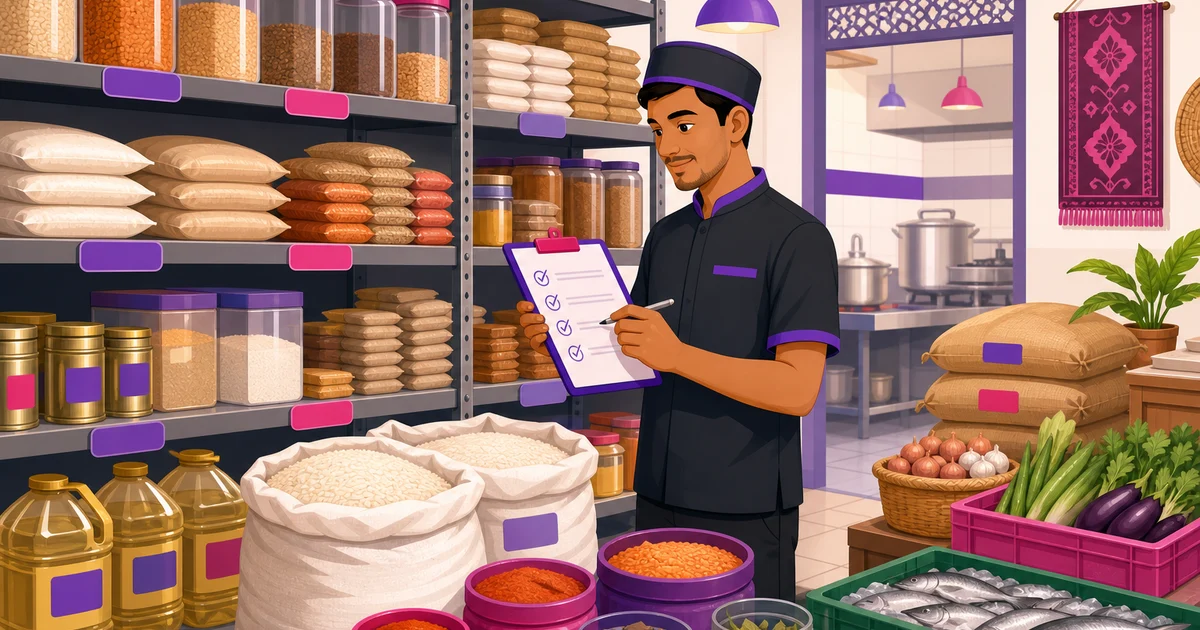
A useful back-office system should create a traceable chain. A stock requirement leads to a purchase order. Goods received change the stock position. Productions convert raw materials into prepared or finished goods. Wastage explains reductions that were not sales. Cost information supports plate-cost reviews. Approved shifts, payroll and advances explain labour cost.
If those records live in separate notebooks, spreadsheets and messaging groups, managers spend their time reconstructing events. If they are never reconstructed, the owner makes decisions from incomplete numbers.
1. Stock items and minimum-stock alerts
Inventory control begins with clearly defined stock items. “Chicken” is not enough if one branch buys whole chicken by kilogram and another receives boneless meat in packets. Each item should have a consistent name, unit, SKU where useful, current cost, supplier and branch-level stock position.
Minimum-stock alerts are not simply reminders to buy. They help prevent costly emergency purchasing. When the regular supplier charges ৳290 per kilogram but an urgent local purchase costs ৳325, a 50-kilogram emergency order adds ৳1,750 before considering transport or quality differences.
A practical stock routine includes:
- Recording purchases in the same unit used for receiving and counting.
- Setting realistic minimum levels based on lead time and average consumption.
- Counting high-value items such as meat, oil, cheese and seafood frequently.
- Keeping branch stock separate rather than combining everything into one balance.
- Investigating the difference between recorded stock and physical stock.
Software cannot replace a physical count. It makes the count useful by giving the manager a recorded balance to compare against.
2. Suppliers and purchase orders
A phone call to a supplier may be convenient, but it creates little control. A proper purchase order should show what was requested, quantity, expected rate, supplier and delivery location. The receiving person can then compare the delivery with the order and supplier invoice.
For any vendor you evaluate, ask to see the full workflow. Can a manager distinguish requested, approved, received and paid purchases? Can partial deliveries be handled? Can the restaurant identify unpaid supplier obligations? Features and terminology vary, so request a live demonstration rather than relying on a checklist.
The core control is simple:
- The kitchen or store raises a requirement based on stock.
- An authorised person reviews quantity and price.
- The supplier receives a clear purchase order.
- The receiver checks actual quantity and condition.
- Accounts verifies the invoice and payment position.
Without this chain, ten cartons requested can become twelve cartons invoiced, while only nine usable cartons reach storage.
3. Productions and yield control
Restaurants often prepare one item from several raw materials before service. Examples include pizza sauce, burger patties, spice paste, bakery dough or a batch of kacchi masala. This is a production process: raw materials are consumed to create a prepared or finished stock item.
The important number is yield. If a standard batch should produce 10 kilograms of sauce but repeatedly produces 8.8 kilograms, the issue may be trimming, evaporation, portioning, measurement or unrecorded use. A production record gives the manager a place to investigate.
Production tracking should not be confused with automatic ingredient deduction for every menu sale. Some systems support detailed recipe integrations and others do not. Ask the vendor to demonstrate exactly how raw materials, production batches and menu sales connect before assuming the process is automatic.
4. Wastage with a reason
“Stock is short” is not a useful explanation. Wastage records should state the item, quantity, branch, date, responsible area and reason. Common reasons include spoilage, overproduction, kitchen error, expired stock, damaged packaging, customer return and staff meal.
Reasons turn loss into something managers can act on. If spoilage is high, review purchasing and storage. If overproduction rises before closing time, adjust prep quantities. If customer returns repeatedly involve one dish, check preparation and portion standards.
Suppose a restaurant records only ৳3,000 of wastage, but the physical stock variance suggests another ৳15,000 is missing. The gap matters. It may indicate receiving errors, unrecorded consumption, counting mistakes or theft. Recording honest wastage is better than hiding it inside an unexplained stock adjustment.
Plate cost can drift while the menu price stays fixed
A recipe that was profitable six months ago may not be profitable now. Chicken, rice, oil, spices, packaging and garnish prices change at different times. Portions also grow when cooks work without measured standards.
Take a chicken rice dish sold for ৳320 before VAT and service charge. Its original ingredient and packaging cost may be:
| Component | Cost |
|---|---|
| Rice | ৳28 |
| Chicken | ৳75 |
| Oil, spices and garnish | ৳27 |
| Packaging or serving consumables | ৳15 |
| Total plate cost | ৳145 |
The theoretical food cost percentage is:
Plate cost ÷ selling price × 100
৳145 ÷ ৳320 × 100 = 45.3%
If the plate cost rises to ৳165 while the selling price remains ৳320, the percentage becomes 51.6%. On 1,000 plates, that ৳20 increase consumes ৳20,000.
Review portions, yields and current purchase prices before deciding whether to change the recipe, renegotiate supply, reduce waste or adjust the menu price. This restaurant recipe-costing guide explains how to build a repeatable costing sheet.
Calculate actual food cost percentage from stock
Plate costing is theoretical. Actual food cost uses opening stock, purchases and closing stock for a period:
Cost of goods consumed = Opening stock + Purchases − Closing stock
Assume the monthly figures are:
- Opening food stock: ৳1,80,000
- Purchases: ৳4,20,000
- Closing food stock: ৳1,50,000
- Net food sales: ৳10,00,000
Cost of goods consumed is ৳4,50,000. Actual food cost percentage is:
৳4,50,000 ÷ ৳10,00,000 × 100 = 45%
If recipe costing suggests 40% but actual food cost is 45%, investigate the five-point gap. Possible causes include wastage, oversized portions, supplier price changes, staff meals, missing purchase records, receiving shortages or inaccurate stock counts. See the detailed food cost percentage calculation for a practical monthly method.
Payroll, shifts and advance salary belong in the same control picture
Food cost is only part of operating cost. Labour can become equally difficult to control when attendance notes, shift changes, overtime and salary advances are kept in a khata.
A useful payroll workflow starts with an approved employee list and pay structure. Rosters or verified attendance records support payable days, absences and overtime. Salary advances are recorded against the employee when issued, then deducted transparently during payroll. The final payroll should show gross pay, approved additions, deductions, advance recovery and net pay.
Ask any software vendor how attendance reaches payroll. Is it entered manually, imported or connected to another system? Can a manager correct an error with authorisation? A shift roster is useful, but it is not automatically proof that an employee attended. The distinction prevents payroll disputes.
Advance salary control is especially important. If five employees each take ৳5,000 during the month and only ৳15,000 is deducted at payroll, the business has an unreconciled ৳10,000 cash outflow.
Prime cost shows whether the core operation is sustainable
Prime cost combines cost of goods consumed and direct labour cost. It is one of the clearest operating indicators for a restaurant:
Prime cost = Cost of goods consumed + Direct labour cost
Using the earlier food cost of ৳4,50,000 and monthly direct labour of ৳2,20,000:
Prime cost = ৳4,50,000 + ৳2,20,000 = ৳6,70,000
As a percentage of ৳10,00,000 net sales:
৳6,70,000 ÷ ৳10,00,000 × 100 = 67%
This leaves 33% before rent, utilities, commissions, repairs, marketing, administrative salaries and profit. There is no single ideal percentage for every Bangladeshi restaurant. Format, service model, location and menu all matter. Track your own trend and investigate movement quickly. Read more about calculating restaurant prime cost.
The category question to ask every software vendor
Do not evaluate restaurant software only by how quickly it prints a bill. Ask: Does it close the loop from purchase to plate cost to payroll?
Request a demonstration using your own scenario. Create a stock item, raise a purchase order, receive goods, record production and wastage, count closing stock, update a plate cost, prepare shifts and process a salary advance. Then ask which steps are connected, which require manual entry and which reports expose a variance.
Rosuii is one Bangladesh-focused platform that covers much of this back-office work alongside POS and online ordering. It includes per-branch stock items, minimum-stock alerts, suppliers, purchase orders, productions, wastage, expenses, employees, shifts, rosters, payroll and advance salaries. Plate costing still requires disciplined recipe, yield and price review, and restaurants should not assume that ingredients are automatically deducted for every menu-item sale.
The goal is not to collect more software screens. It is to create records managers can check before small leaks become a bad month.
Start with one weekly back-office review
Choose a fixed day. Review high-value stock variance, unapproved or unmatched purchases, wastage by reason, changed supplier prices, production yields, salary advances and projected prime cost. Thirty focused minutes with reliable records can be more valuable than another discount campaign.
If you want to manage sales and key back-office operations in one bilingual, Bangladesh-focused system, register for Rosuii and start free. There is no setup fee, and you can begin with one branch before deciding what level fits your operation.
Last updated:
Frequently asked questions
What is restaurant back office software?
How often should a restaurant count stock?
What is the difference between plate cost and actual food cost?
Should salary advances be treated as a restaurant expense immediately?
Does Rosuii automatically deduct recipe ingredients whenever a dish is sold?
Run your restaurant on Rosuii
POS, menu, inventory, payroll and more — built for Bangladeshi restaurants.
Start free