Restaurant Food Safety Inspection Records Bangladesh
A compact evidence file that shows what the restaurant checked, who checked it and how a problem was corrected.
Last verified: 2026-08-28
Restaurant food safety inspection records should prove daily control, not create paperwork after an inspector arrives. Start with the duties in current BFSA laws and the Food Business Operator Obligations Regulations, then keep only records that support the restaurant's actual hazards and procedures.
A useful record has date and time, item or area, measured or observed result, responsible person and corrective action. A tick without evidence or follow-up is weak.
Core inspection record set
| Record | Minimum evidence | When |
|---|---|---|
| Approved supplier and receiving | Supplier, item, condition, date | Every delivery |
| Cold or hot holding check | Item, actual reading, action | Risk-based schedule |
| Cleaning and sanitizing | Area, task, person | Each shift/day |
| Pest observation | Location, sign, action | Routine and incident |
| Staff illness and hygiene | Report and duty decision | As reported |
| Complaint or suspected food incident | Order, item, trace and action | Every incident |
Supplier and receiving evidence
Keep supplier identity, invoice or delivery note, received item, date, quantity and condition. Reject or isolate damaged, contaminated, spoiled or temperature-abused food according to the restaurant's documented rule.
Link ingredients to the supplier and receiving date where practical. This shortens investigation when a complaint affects one batch.
Operational control logs
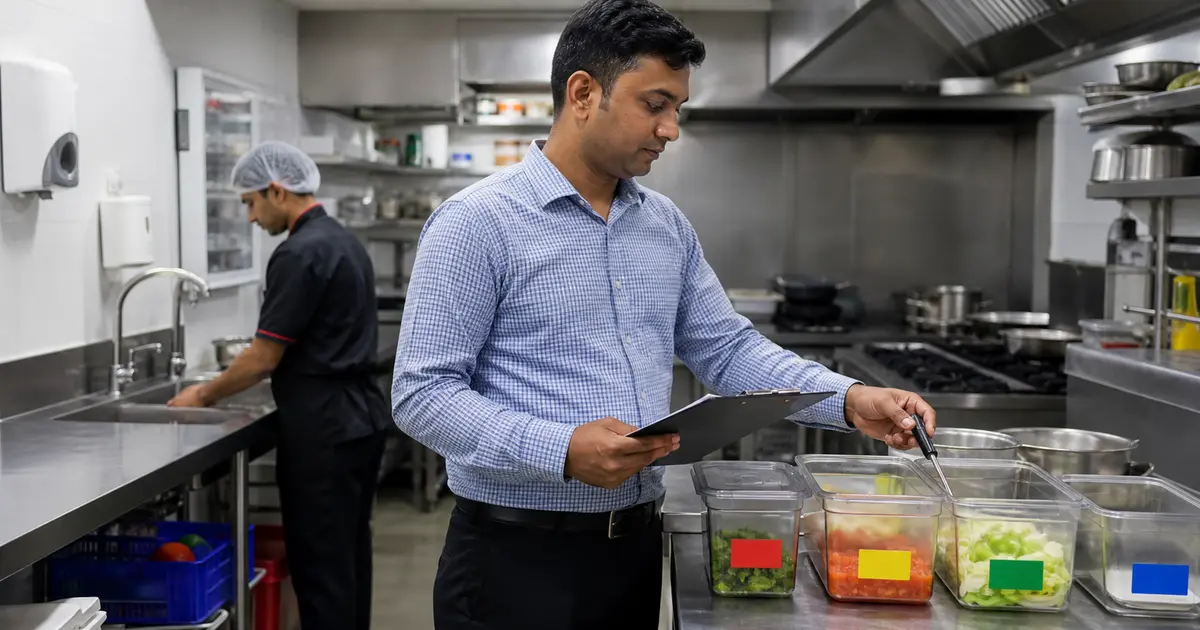
Use calibrated measuring tools where a temperature is part of the control. Record the actual result rather than writing okay. If the result falls outside the restaurant's validated limit, write whether food was moved, reheated, discarded or escalated.
Cleaning records should name the area and task. A signed sheet that says kitchen clean without checking slicers, drains, handles, storage and food-contact surfaces is too vague.
People and training records
Maintain induction and refresher training attendance, topics, trainer and any competency check. Keep an illness-reporting route so a worker can report symptoms without hiding them to protect a shift.
Assign a food-safety lead per shift. The manager should review missed checks and corrective actions, not simply collect forms.
Inspection-day file
- Current licenses and authority contacts
- Food-safety responsibility chart
- Supplier and receiving evidence
- Recent control and cleaning logs
- Pest-control records
- Training and illness procedure
- Complaint and corrective-action log
- Equipment maintenance and calibration where used
Digital record rules
A spreadsheet or software record is useful only if staff can enter it at the work area, revisions are controlled and evidence can be exported. Restrict deletion and keep backup according to the restaurant's retention policy and applicable requirements.
Rosuii purchase and inventory records can support supplier and stock traceability, but they do not replace every BFSA-required or risk-specific food-safety document. Map each official duty to the evidence your restaurant keeps.
Build the record set from the actual food-safety plan
A record is useful only when it reflects a defined control, responsible person, method, acceptable limit or decision rule, review and corrective action. Copying a generic logbook can create pages of ticks that do not represent the restaurant's food, equipment or applicable requirements. Obtain qualified food-safety and authority guidance for the specific operation.
Map receiving, storage, preparation, cooking, holding, cooling where used, cleaning, pest control, staff training, illness reporting and supplier approval to the restaurant's procedures. Keep only records that staff can perform and supervisors can verify.
Record design matrix
Do not backfill routine records from memory. If a record was missed, document the missed control and corrective response honestly rather than creating a false timestamp.
| Field | Purpose | Quality test |
|---|---|---|
| Date/time | Place the event | Occurrence, not later memory |
| Item/batch/location | Identify scope | Specific enough to trace |
| Observation/measurement | Record what happened | Unit and method present |
| Limit/rule | Support decision | Approved current procedure |
| Result | Pass, fail or other defined state | No pre-filled tick |
| Correction | Control immediate risk | Action and affected item |
| Verification | Supervisor review | User and time |
| Instrument | Link measurement tool where relevant | Status/check record |
Digital record integrity
Use individual accounts, role-based editing, occurrence time, server receipt time and an append-only correction history. Offline capture should show pending sync and prevent duplicate events. Photos can support evidence but should not replace a required measurement or create unnecessary personal data.
Back up records, test retrieval and define retention based on legal and operational review. Export should preserve units, user, time, correction and source context—not only a green dashboard summary.
Inspection-day retrieval test
Assign one authorized contact to locate records and answer factually. Do not fabricate a missing record during an inspection. State what exists, preserve any notice and follow the official response route.
- Current approved procedures
- Premises and business records requested
- Supplier and receiving trace
- Relevant batch or item controls
- Cleaning and pest records
- Training and responsibility records
- Instrument checks where applicable
- Open corrective actions
- Prior inspection response and closure evidence
Weekly verification and corrective action
Review missing logs, repeated limit failures, unresolved corrective actions, unusual perfect data, instrument issues and user access. Sample source events and observe whether the recorded procedure matches actual work. A high completion percentage does not prove the control is effective.
For every material failure, record immediate control, affected product decision, root-cause review, preventive action, owner and verification date. Close the action only after evidence shows the required step was completed. This article supports record design and is not a substitute for an inspector or qualified food-safety professional.
Run a retrieval drill using a selected supplier receipt, ingredient or finished item and a defined service period. Authorized staff should locate the relevant receiving, storage, production and corrective-action evidence without editing it. Record missing links and improve identifiers or filing. The drill does not prove legal compliance or food safety, but it shows whether the restaurant can use its own records during a real review or incident.
The best inspection file is small enough to complete every day and detailed enough to explain a failure. Record actual observations, corrective action and management review.
Related guides
- BFSA Food License for Restaurants
- Food Safety and Hygiene Checklist
- Opening and Closing Checklist
- Compare restaurant management software
See this workflow in Rosuii: Use Rosuii purchase, inventory and branch records
Sources checked
Last updated:
Frequently asked questions
Which food safety records should a restaurant keep?
Does every restaurant need the same logs?
Is a tick-box checklist enough?
Can records be digital?
Does POS inventory replace food-safety records?
Which food-safety records should a restaurant keep?
Can restaurant food-safety logs be digital?
Should a missing record be filled in later?
Who should verify digital inspection records?
Run your restaurant on Rosuii
POS, menu, inventory, payroll and more — built for Bangladeshi restaurants.
Start free