Skip to content
RosuiiRosuii

Restaurant VAT Rate in Bangladesh: What Applies and How It Shows

What the restaurant VAT rate in Bangladesh actually is, why it differs from the 15% standard, how it has changed recently, and how VAT and service charge appear line by line on a bill.

By Rosuii Team6 min read
Share
Restaurant VAT Rate in Bangladesh: What Applies and How It Shows

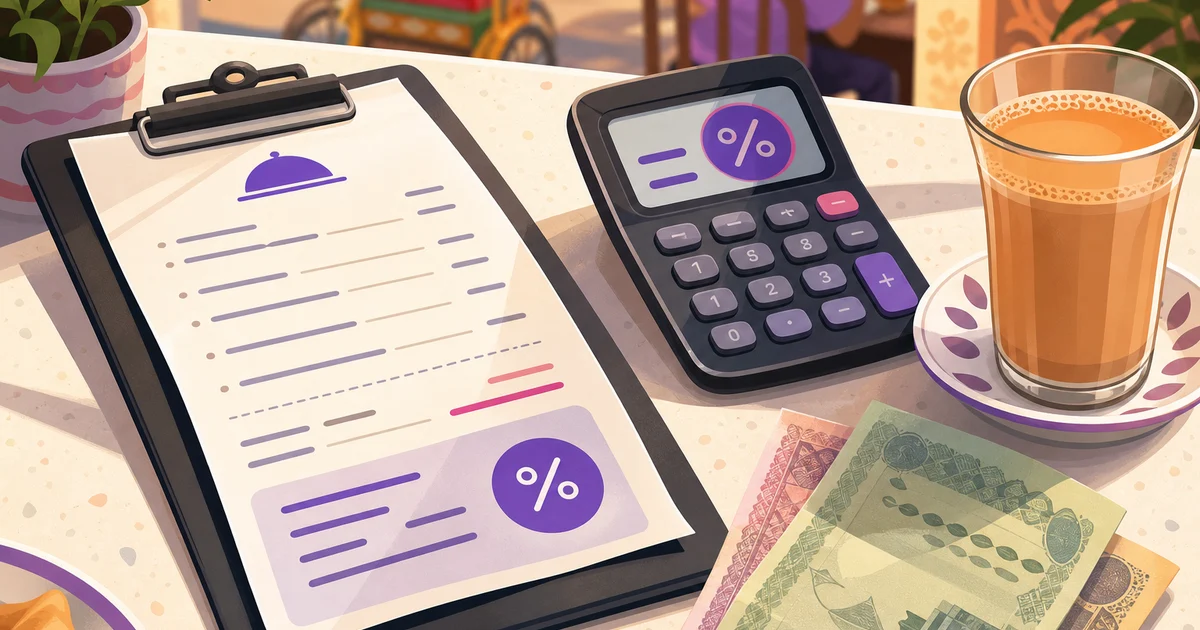
The restaurant VAT rate in Bangladesh is one of those numbers everyone asks about and few state with confidence, for a good reason: it moves. The National Board of Revenue (NBR) sets it, it has differed by type of establishment over the years, and it has changed more than once recently. This guide explains what rate applies to restaurant service, why it is not the same as the headline 15% VAT, how it has shifted, and how VAT and service charge should appear on the bill. Treat every figure here as a pointer to check, not a final answer; the rate that matters is the one in the current SRO for your exact category, which you should confirm with the NBR (nbr.gov.bd) or a VAT consultant.

The restaurant rate is not the 15% standard rate

Bangladesh's standard VAT rate is 15%. That is the headline figure, and it applies broadly across taxable supplies. Restaurant service, however, sits under a reduced rate that the NBR notifies separately. So a restaurant does not simply charge 15% on a meal; it charges the specific restaurant-service rate the NBR has set, which has generally been lower than the standard rate.

This is why quoting a single number is risky. The figure depends on which category your establishment falls in and on the rate in force at the time, and that rate is updated through Statutory Regulatory Orders (SROs) and the national budget. A percentage that was correct two years ago may not be correct now.

As of writing: the commonly cited figure

As of writing, the restaurant-service VAT rate is commonly cited as 5% for FY 2025-26. There is a recent story behind that number. The rate had been raised sharply (toward the 15% standard) early in 2025, but after strong objection from restaurant owners, the NBR reversed the increase and restored restaurant service to the previous 5%. Certain establishments are usually treated differently, for example restaurants inside higher-category star hotels or those serving alcohol, which can fall under different rates. Because this is exactly the kind of figure that changes, do not hardcode 5% in your head; confirm the current SRO for your category with the NBR or your VAT consultant.

Why the rate has changed so much

Restaurant VAT has been unusually eventful. Over the past several years the rate has been cut, split by air-conditioned versus non-air-conditioned status, unified, raised, and rolled back again. The January 2025 episode is a clear example: a steep increase was announced, the sector protested, and the rate was brought back down within weeks. The practical lesson is not to memorise any single number but to build a habit of checking the current SRO and updating your system when it changes.

For the wider mechanics of how VAT works for a restaurant, including registration and your BIN, see our guides to NBR VAT registration for a restaurant and restaurant VAT and service charge.

VAT and service charge are different lines

Customers often see two extra lines at the bottom of a bill and treat them as one charge. They are not the same:

  • VAT is a government tax. You collect it for the NBR and pass it on. It is not your income, and the rate is set by the government.
  • Service charge is a fee the restaurant adds for service, kept by the business and often shared with staff. There is no fixed legal rate; you set it and should disclose it to the customer.

One line goes to the government, the other stays with the restaurant. They belong on the bill as separate, labelled lines so both you and the customer can see what is tax and what is your charge. We cover service charge in depth in restaurant VAT and service charge.

How VAT and service charge appear on a bill

A clean restaurant bill applies charges in a fixed sequence so the total is reproducible. A typical order looks like this:

StepLineWhat it does
1Items subtotalThe sum of the dishes and drinks ordered.
2Discount or couponSubtract any promotion or loyalty redemption.
3Service chargeAdd the restaurant's percentage, if you charge one.
4VATApply the current restaurant VAT rate.
5Grand totalThe amount the customer pays.

The order matters because whether VAT is calculated before or after service charge changes the final total. Pick a consistent sequence and apply it the same way on every bill. Doing this by calculator for each table is slow and error-prone, especially when a discount, a coupon and loyalty points are all in play at once, and one wrong step throws off your VAT figure.

Show VAT separately, never inside the price

VAT has to be visible as its own line, calculated on the taxable value, not folded into menu prices. Burying tax in the price might feel customer-friendly, but it breaks your tax invoice (the Mushak 6.3) and your reporting, and it can confuse a VAT inspector. For what the invoice itself must contain, see our guide to the Mushak 6.3 VAT challan.

A worked example (illustrative only)

To show the mechanics, here is an illustrative bill using a 5% VAT rate and a 10% service charge. These percentages are for illustration; use your own current figures.

  • Items subtotal: ৳1,000
  • Service charge at 10%: +৳100, giving ৳1,100
  • VAT at 5% on ৳1,100: +৳55
  • Grand total: ৳1,155

Change the VAT rate, the service-charge percentage, or the order of the two, and the total changes. That is precisely why the rate and the calculation order should be set once in software and applied automatically, rather than worked out by hand at the counter on a busy night.

How Rosuii applies the rate and prints the bill

Rosuii does not decide your VAT rate for you or file your return; it is not a tax filing service and does not submit anything to the NBR on your behalf. What it does is apply the rate you set, consistently, on every sale, and print a clean itemised bill. You enter your business name and BIN, set your restaurant VAT rate and service charge once in settings, and the system handles the rest.

In practice:

  • Pricing is calculated on the server in a fixed order: discount, then coupon, then loyalty, then service charge, then VAT. The total is the same whoever rings it up and whether it is dine-in, takeaway, delivery or an online order.
  • Every bill shows items, discount, service charge and VAT as separate, labelled lines, with your business name and BIN, so it reads as a proper tax invoice.
  • When the budget or an SRO changes the rate, you update it once and every future bill uses the new figure automatically. No reprinting price lists, no retraining cashiers on new maths.
  • The same VAT breakdown flows into your reports and day-close Z-report, so the VAT you collected reconciles with what you file. See restaurant sales, P&L and Z-reports.

That keeps the part you control accurate, while the rate itself stays your call to set from the current SRO. To see how the bill fits the wider system, look at restaurant POS software and restaurant billing software.

This article is general guidance, not tax advice. The restaurant VAT rate is set by the NBR and changes, often in the national budget or through an SRO. Always confirm the current rate for your exact establishment type with the NBR (nbr.gov.bd) or a qualified VAT consultant before relying on a figure.

Want bills that apply your VAT rate the same way every time and update in one click when it changes? Create your free Rosuii account and set your rate once.

Updated:

Frequently asked questions

What is the restaurant VAT rate in Bangladesh?
The rate is set by the NBR and is lower than the 15% standard. As of writing it is commonly cited as 5% for restaurant service for FY 2025-26, after a sharp increase in early 2025 was rolled back following protests from restaurant owners. Some establishments, such as those in higher-category hotels or serving alcohol, can differ. Confirm the current SRO for your category with the NBR or a VAT consultant.
Why isn't the restaurant rate just 15%?
15% is Bangladesh's standard VAT rate, applied broadly to taxable supplies. Restaurant service sits under a reduced rate the NBR notifies separately, which has generally been lower than the standard rate. So a restaurant charges the specific restaurant-service rate in force, not the headline 15%. Because that reduced rate changes, confirm the current figure rather than assuming.
Is VAT calculated before or after service charge?
There is no single legal answer, but you must be consistent, because the order changes the final total. A common sequence is items, then discount or coupon, then service charge, then VAT. Pick one order and apply it the same way on every bill. A POS enforces this automatically so it is never done two different ways across staff or shifts.
Should VAT be shown separately on the bill?
Yes. VAT must be visible as its own labelled line, calculated on the taxable value, not folded into menu prices. Hiding tax inside the price breaks your Mushak 6.3 tax invoice and your reporting and can confuse a VAT inspector. The bill should show items, any discount, service charge and VAT as separate lines, with your BIN.
How does Rosuii handle a changing VAT rate?
You set your restaurant VAT rate once in Rosuii, and every bill applies it in a fixed order with VAT shown as its own line. When the budget or an SRO changes the rate, you update it once and every future bill uses the new figure automatically, with no reprinting or retraining. Rosuii does not set your rate or file your return; it applies the rate you choose. Try it free at https://rosuii.com/register.

Run your restaurant on Rosuii

POS, menu, inventory, payroll and more — built for Bangladeshi restaurants.

Start free
Best Restaurant POS Software in Bangladesh: A Buyer's Guide (2026)

Best Restaurant POS Software in Bangladesh: A Buyer's Guide (2026)

The best restaurant POS software in Bangladesh takes bKash and Nagad, calculates VAT and service charge correctly, works in Bangla, and prints clean receipts. Here is the full checklist, plus where Rosuii fits and one honest caveat about offline use.

By Rosuii TeamJun 22, 20267 min read
Best Restaurant Software in Bangladesh: 7 Options Compared (2026)

Best Restaurant Software in Bangladesh: 7 Options Compared (2026)

The best restaurant software in Bangladesh is the one built for how you actually run, with real bKash and Nagad, full Bangla, and BDT pricing. Here are 7 options compared on the criteria that matter, plus a simple way to pick.

By Rosuii TeamJun 22, 20267 min read