Skip to content
RosuiiRosuii

Restaurant Opening Cost in Bangladesh: একটা রেস্টুরেন্ট খুলতে কত টাকা লাগে?

A practical breakdown of restaurant setup costs in Bangladesh, from rent advance and kitchen equipment to licences, marketing and six-month cash reserves.

By Rosuii Team8 min read
Share
Restaurant Opening Cost in Bangladesh: একটা রেস্টুরেন্ট খুলতে কত টাকা লাগে?

Restaurant opening cost in Bangladesh usually starts at around ৳8 lakh for a small neighbourhood outlet, rises to ৳25-50 lakh for a mid-range family restaurant, and can cross ৳1 crore for premium fine dining. These are indicative, Dhaka-leaning estimates. Your actual figure will depend heavily on location, rent advance, seating capacity, cuisine, kitchen specifications and how much renovation the property needs.

বাংলায় সরাসরি উত্তর দিলে, একটা রেস্টুরেন্ট খুলতে কত টাকা লাগে? A basic 15-20 seat restaurant may need roughly ৳8-15 lakh before opening. A professionally fitted 40-60 seat restaurant may require ৳25-50 lakh. But that is only the setup budget. You should also protect enough working capital to survive the first six months.

Restaurant opening cost in Bangladesh by restaurant type

Restaurant typeTypical capacityIndicative opening costSuitable format
Small neighbourhood restaurant15-20 seats৳8-15 lakhFast food, biryani, snacks, café or local meals
Mid-range family restaurant40-60 seats৳25-50 lakhBangla, Chinese, Indian, casual dining or multi-cuisine
Premium fine dining60 seats or more৳1 crore+Prime location, premium interior, imported equipment and larger service team

These figures cover the normal expenses required to prepare and launch the outlet. They do not automatically include a full six-month operating reserve. Rent in Gulshan, Banani or Dhanmondi can produce a very different budget from rent in Mirpur, Uttara, Mohammadpur or a district town. Before signing a property, prepare a location-specific business plan rather than relying on a national average. Our restaurant business plan guide for Bangladesh can help structure that calculation.

Itemized opening budget for a restaurant

The following ranges show where the opening money normally goes. They are planning estimates rather than supplier quotations. Get at least three written quotations for major equipment, renovation and signage before committing funds.

Cost categorySmall restaurantMid-range restaurantPremium restaurant
Space advance and deposits৳1.5-3 lakh৳4-9 lakh৳15-30 lakh+
Renovation and décor৳1.5-3 lakh৳6-13 lakh৳25-50 lakh+
Kitchen equipment৳2-3.5 lakh৳6-11 lakh৳20-35 lakh+
Furniture and service items৳60,000-1.2 lakh৳2.5-5 lakh৳10-20 lakh+
Licensing and professional costs৳30,000-80,000৳60,000-1.5 lakh৳1-3 lakh+
Initial food and packaging stock৳30,000-60,000৳80,000-1.8 lakh৳2-5 lakh+
Staff recruitment and advances৳40,000-80,000৳1.2-2.5 lakh৳3-8 lakh+
Signboard and opening marketing৳30,000-70,000৳1-2.5 lakh৳4-10 lakh+

Add a contingency allowance of at least 10 percent. Electrical upgrades, exhaust ducting, drainage repairs, gas arrangements and landlord requirements often appear after renovation begins.

1. Space advance, deposit and pre-opening rent

Commercial landlords commonly ask for several months of advance or security deposit. The exact arrangement is negotiated and can vary sharply by building and area. Include advance rent, utility deposits, brokerage, legal documentation and rent paid while the site is being renovated.

A cheap monthly rent does not always mean a cheap site. A property without adequate electrical load, drainage, ventilation or legal cooking arrangements may cost more to convert than a slightly more expensive restaurant-ready space. Check whether the building permits your intended use before paying a non-refundable amount.

2. Renovation, décor and utility work

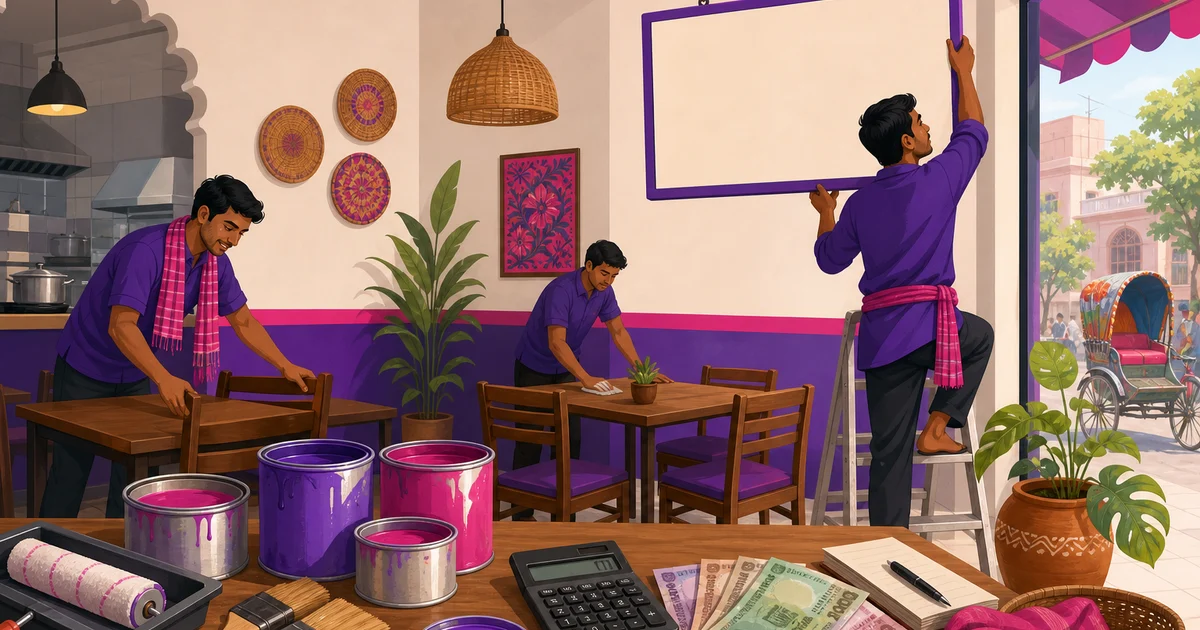
Renovation includes flooring, paint, ceiling, lighting, washroom work, counters, plumbing, electrical wiring, air conditioning, exhaust ducts and fire-safety preparation. Many new owners focus on wall panels and photo-friendly décor but underestimate the operational work hidden behind the kitchen.

Prioritise washable surfaces, safe wiring, drainage, ventilation and an efficient movement path between storage, preparation, cooking, washing and service. Attractive décor matters, but it should not make the kitchen slower or harder to clean.

3. Kitchen equipment

Your equipment list should come from the menu, not from a generic supplier package. A biryani operation, bakery, café and Chinese restaurant require different heat sources, refrigeration and preparation tools.

  • Cooking ranges, burners, ovens, fryers or grills
  • Refrigerators, freezers and cold-storage racks
  • Exhaust hood, ducting and ventilation equipment
  • Preparation tables, sinks, shelves and storage bins
  • Blenders, mixers, rice cookers and cuisine-specific machines
  • Knives, pots, pans, utensils and food-grade containers
  • Fire extinguishers and other required safety equipment

Imported or branded equipment can push the budget upward quickly. Used equipment can reduce the initial cost, but inspect compressors, heating elements, rust, electrical safety and spare-parts availability before buying.

4. Furniture, crockery and front-of-house items

Budget for tables, chairs, counters, shelving, crockery, glassware, cutlery, trays, uniforms, menu displays and waste bins. Allow for breakage and replacement stock. For a high-volume outlet, durable commercial furniture usually costs less over time than decorative household-grade products.

5. Licences and registrations

A restaurant licensing package may involve a trade licence from the relevant local authority, VAT or BIN registration, fire licence or fire-safety approval, and environmental clearance where the operation or location requires it. Depending on the business structure and premises, other permissions or food-safety requirements may also apply.

BIN registration itself is generally handled through the National Board of Revenue system, but professional assistance, document preparation and related compliance work may create costs. Trade licence fees and renewals vary by local authority and business category. Fire and environmental requirements depend on the premises, operation and applicable classification. Signboard tax or local charges may also apply.

Do not treat a single consultant's quote as the official government fee. Ask for an itemized statement separating government charges, professional fees and renewals. Rules and rates can change, so confirm the current requirements with the relevant city corporation or municipality, VAT circle, fire authority and environmental authority. For the wider sequence, read how to open a restaurant in Bangladesh.

6. Initial food stock and packaging

Your opening stock includes raw materials, beverages, spices, cleaning chemicals, takeaway boxes, cups, tissues and delivery packaging. Avoid buying a month's worth of perishables before you know actual demand. Purchase enough for training, a soft opening and the first operating cycle, then replenish based on sales.

Set units, minimum-stock levels and supplier details from the beginning. Stock control is easier when every purchase, production batch and wastage entry is recorded consistently.

7. Staff recruitment, training and salary advances

Pre-opening payroll starts before revenue. Chefs may need time for menu testing, costing and kitchen setup. Service staff need training on order taking, hygiene, table numbers and complaint handling. Include recruitment expenses, uniforms, meals, advances and salaries paid during trial operations.

A small outlet may start with a chef, helper, service staff and cashier or manager. Larger restaurants require clearer roles across kitchen stations, cleaning, service, cash control, purchasing and supervision.

8. Signboard and opening marketing

Include exterior signage, menu photography, printed materials, launch offers, local social advertising and food-content production. A large launch campaign cannot rescue weak food or slow service. A controlled soft opening is often better because it lets the team fix kitchen timing, portion inconsistencies and billing problems before promoting heavily.

The biggest budgeting mistake: no six-month working capital

Many owners spend nearly everything on décor and equipment. They then open with little cash left for rent, salaries, ingredients, utilities and marketing. This is one of the most dangerous restaurant budgeting mistakes.

Sales rarely become predictable immediately. Delivery-platform settlements may not match daily cash needs, seasonal demand can change, and food costs may rise. Keep a separate reserve for the first six months. At minimum, calculate these monthly commitments:

  • Rent and service charges
  • Employee salaries, meals and benefits
  • Electricity, gas, water and internet
  • Minimum food and packaging purchases
  • Cleaning, repairs and pest control
  • Marketing and marketplace commissions
  • Loan payments, VAT and other statutory obligations

A small restaurant may need another ৳6-12 lakh as a practical cash cushion, while a mid-range outlet may need ৳15-35 lakh or more. These are broad examples, not fixed rules. Build your reserve from your own monthly expense forecast. See our guide to restaurant running costs in Bangladesh for a detailed operating-cost checklist.

Can a cloud kitchen reduce the opening cost?

Yes. A lean cloud kitchen can sometimes start around ৳3-8 lakh because it does not require a dining room, customer washroom, premium frontage or expensive seating. The budget still needs to cover rent advance, kitchen equipment, exhaust and safety work, licences, packaging, menu photography and online marketing.

Cloud kitchens are not automatically easy or profitable. Delivery commission, discounting, packaging and customer-acquisition costs can consume a large share of each order. Location still matters because delivery distance affects food quality and delivery time. Read the cloud kitchen setup cost guide for Bangladesh before choosing this route.

Keep restaurant software costs proportionate

Software should control leakage and save time, not consume the opening budget. Rosuii is free to start and has paid plans from ৳500 to ৳2,500 per month, with no setup fee. Every plan includes a branded subdomain and an isolated database for the restaurant.

  • Free, ৳0: POS for one branch with dine-in, takeaway and delivery, menu management, tables, customers and basic reports. Online ordering is not included.
  • Starter, ৳500 per month: Up to two branches, plus online ordering, inventory, purchasing and reservations.
  • Growth, ৳1,200 per month: Up to three branches, plus kitchen and customer displays, payroll, CRM, loyalty and export reports.
  • Pro, ৳2,500 per month: Unlimited branches and orders, marketplace tools, payment gateway features and the complete feature set.

The browser-based POS works on a phone, tablet or laptop, so there is no mandatory hardware lock-in. After a one-tap offline-data sync saves the menu and customers on the device, billing can continue during an internet outage. Orders queue locally and sync automatically when the connection returns. Online bKash or Nagad confirmation and live multi-device or KDS updates still require connectivity.

A practical budget approval checklist

  1. Finalize the concept, target customer and menu before selecting equipment.
  2. Inspect electrical load, drainage, exhaust access and cooking restrictions before paying an advance.
  3. Get itemized quotations for renovation, kitchen equipment and licences.
  4. Separate opening costs from the six-month working-capital reserve.
  5. Add at least 10 percent contingency for unexpected site work.
  6. Use a soft opening to test portions, preparation times, pricing and service.
  7. Track every sale, expense, purchase and wastage from day one.

A realistic opening budget protects the business long after the signboard goes up. Spend first on food quality, safety, kitchen flow and cash reserves. Decorate within what remains, not the other way around.

Ready to set up billing, inventory and reporting without a large software investment? Register for Rosuii and start free.

Share

Frequently asked questions

How much money is needed to open a small restaurant in Bangladesh?
A small 15-20 seat neighbourhood restaurant may require roughly ৳8-15 lakh for rent advance, renovation, kitchen equipment, furniture, licences, opening stock, staffing and launch marketing. Keep a separate six-month working-capital reserve where possible.
Can I open a restaurant in Bangladesh with ৳5 lakh?
A conventional dine-in restaurant will be difficult to open properly with ৳5 lakh, especially in Dhaka. A small takeaway counter, home-based food operation or lean cloud kitchen may be possible if rent and equipment requirements are low, but licensing, safety and working capital still need to be budgeted.
How much does a restaurant licence cost in Bangladesh?
There is no single nationwide package price. Costs vary by local authority, business category, premises and required approvals. The package may involve a trade licence, BIN or VAT registration, fire-related approval and environmental clearance where applicable. Ask for an itemized breakdown of government fees, professional charges and renewal costs.
How much working capital should a new restaurant keep?
Plan for up to six months of rent, payroll, utilities, minimum stock purchases, maintenance and marketing. A small outlet may need roughly ৳6-12 lakh in reserve, while a mid-range restaurant may require ৳15-35 lakh or more, depending on its monthly fixed costs.
Is a cloud kitchen cheaper than a dine-in restaurant?
Usually yes. A lean cloud kitchen may start at roughly ৳3-8 lakh because it avoids dining-room furniture and premium frontage. However, it still needs a compliant kitchen, equipment, rent advance, packaging, licences, marketing and enough cash to cover delivery commissions and early operating losses.

Run your restaurant on Rosuii

POS, menu, inventory, payroll and more — built for Bangladeshi restaurants.

Start free
Best Restaurant POS Software in Bangladesh: A Buyer's Guide (2026)

Best Restaurant POS Software in Bangladesh: A Buyer's Guide (2026)

The best restaurant POS software in Bangladesh takes bKash and Nagad, calculates VAT and service charge correctly, works in Bangla, and prints clean receipts. Here is the full checklist, plus where Rosuii fits and one honest caveat about offline use.

By Rosuii TeamJun 22, 20267 min read
Best Restaurant Software in Bangladesh: 7 Options Compared (2026)

Best Restaurant Software in Bangladesh: 7 Options Compared (2026)

The best restaurant software in Bangladesh is the one built for how you actually run, with real bKash and Nagad, full Bangla, and BDT pricing. Here are 7 options compared on the criteria that matter, plus a simple way to pick.

By Rosuii TeamJun 22, 20267 min read