Restaurant Break-Even Analysis: Formula, Example and Template
Calculate the sales and order volume your restaurant needs before it starts producing operating profit—and test how price or cost changes move the target.
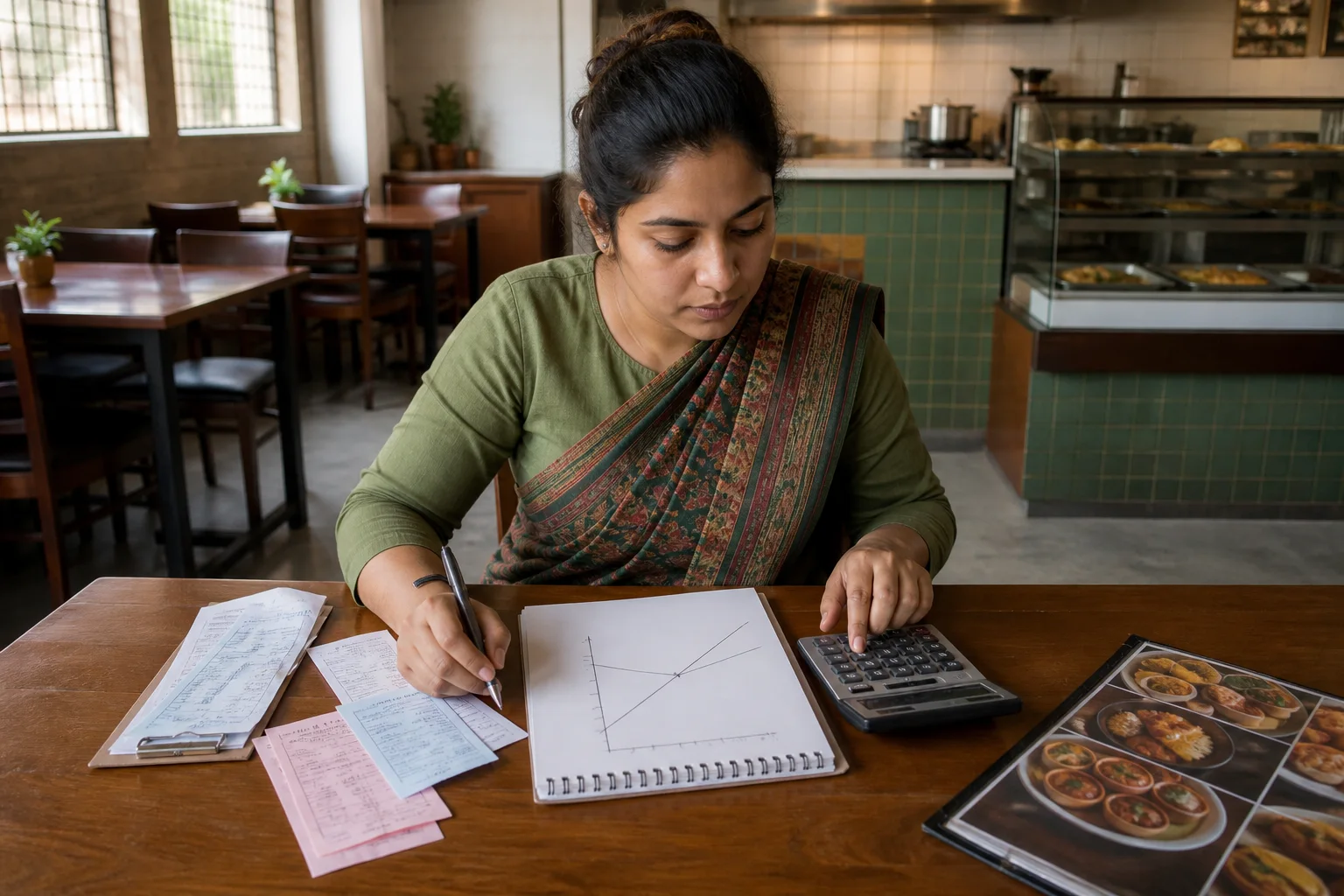
Restaurant break-even analysis calculates the sales or order volume at which total revenue equals total operating cost. Below that point the restaurant makes an operating loss; above it, each additional sale contributes toward profit, assuming the cost pattern holds.
The calculation is a planning model, not a promise. Ingredient mix, discounting, delivery commission, waste and staffing can change the contribution on different orders. Use consistent historical data, state your assumptions and update the model when price or operations change.
Restaurant break-even formulas
When you know the contribution margin ratio, break-even sales = fixed costs ÷ contribution margin ratio. Contribution margin ratio = (sales − variable costs) ÷ sales. To calculate order volume, break-even orders = fixed costs ÷ average contribution per order.
Classify costs by behavior for the chosen period. A cost can be operationally important without being fixed, and labels may differ for accounting or tax. The model only works when the classification matches how the cost changes with sales.
- Contribution = sales − variable costs
- Contribution margin ratio = contribution ÷ sales
- Break-even sales = fixed costs ÷ contribution margin ratio
- Contribution per order = average order value − variable cost per order
- Break-even orders = fixed costs ÷ contribution per order
Fixed versus variable restaurant costs
Fixed costs generally do not change directly with each order within the relevant range: base rent, core salaried management, recurring software, insurance and many licences. Step-fixed costs can jump when volume crosses a threshold—for example, another supervisor or kitchen line.
Variable costs move with orders: food and beverage ingredients, order packaging, payment fees, per-order marketplace commission and some delivery costs. Hourly labour may be partly variable; use the behavior that matches your scheduling and the period you are modelling.
- Do not put all payroll into one category without analysis
- Use net sales after discounts and refunds
- Include channel-specific commission and packaging
- Separate owner drawing from operating cost appropriately
- Keep VAT or tax treatment consistent with the sales figure
- Document every assumption
Worked BDT break-even example
Assume a restaurant has monthly fixed operating costs of ৳360,000. Monthly net sales are ৳800,000 and variable costs are ৳480,000. Contribution is ৳320,000, so the contribution margin ratio is 40%.
Break-even sales = ৳360,000 ÷ 0.40 = ৳900,000 per month. If the average order value is ৳900 and variable cost per order is ৳540, contribution per order is ৳360. Break-even orders = ৳360,000 ÷ ৳360 = 1,000 orders per month.
- At 30 trading days: about 34 orders per day
- At 26 trading days: about 39 orders per day
- This is an illustrative model, not a benchmark
- A different channel mix can change contribution per order
Add target profit to the calculation
Break-even only covers costs. For a target operating profit, use required sales = (fixed costs + target profit) ÷ contribution margin ratio. With the same 40% ratio and a ৳120,000 target, required sales are (৳360,000 + ৳120,000) ÷ 0.40 = ৳1,200,000.
If the desired return is after financing, tax or owner compensation, define this carefully with your accountant. Mixing operating profit, cash requirement and owner withdrawal creates a target no manager can interpret.
Calculate by channel and daypart
Dine-in, direct online orders and marketplace delivery can have different prices, packaging, fees and discount patterns. A single blended contribution margin can hide an unprofitable channel. Calculate contribution by material channel, then create a weighted model from the expected sales mix.
Lunch and dinner can also behave differently. If a quiet daypart needs extra labour and produces heavy waste, total daily sales may look acceptable while that period destroys contribution. Use hourly or shift reports to test it.
Sensitivity analysis: find the dangerous assumption
Change one assumption at a time. Test ingredient cost +5%, average discount +2 percentage points, order volume −10%, average order value +৳50, or an added monthly fixed cost. Recalculate break-even and compare the movement.
The assumption that moves the target most deserves management attention. If a small food-cost increase creates a large break-even jump, prioritize supplier pricing, portion control, waste and menu price review before spending to chase more traffic.
How to lower restaurant break-even
Lowering the break-even point does not mean cutting every cost. Improve contribution on reliable demand and remove fixed commitments that do not protect capacity or guest value. Small gains compound when applied to every order.
- Reprice items after recipe and competitor review
- Promote high-contribution, operationally reliable items
- Reduce waste and portion inconsistency
- Control discounts, refunds and unrecorded consumption
- Improve direct-order mix where acquisition cost allows
- Schedule labour around hourly demand
- Renegotiate or remove underused fixed commitments
- Raise average order value with relevant add-ons
Common break-even mistakes
Using gross sales instead of net sales, excluding owner labour, ignoring delivery fees, treating all labour as fixed, using recipe cost instead of actual cost, and applying one margin to every channel can create a comforting but false target.
Another mistake is treating break-even sales as cash flow. A restaurant can reach accounting break-even while supplier, loan or equipment cash timing creates a shortage. Pair the model with a rolling cash-flow forecast.
Build the template from restaurant data
Create an assumptions tab, fixed-cost table, variable-cost table, sales and channel mix, contribution calculation, break-even result, target-profit result and sensitivity table. Lock formula cells and date every version.
Rosuii can provide net sales, order count, payment, discount, inventory purchase, payroll and expense records used as inputs. Confirm completeness and classifications outside the system; the model is only as reliable as its source data.
Review the model with actuals
After each period, compare assumed price, order mix, variable cost, fixed cost and operating days with actual records. Preserve the original version and explain material differences before changing the next model. Refresh break-even when rent, payroll structure, recipe cost, channel fee, hours or capacity changes; do not adjust an assumption silently to make a target look easier.
Use sensitivity rows to show which assumption moves the result most. This is a planning model, not a guarantee or a substitute for formal accounts. An accountant should review classification and tax treatment where required, while the operator verifies that orders, stock, payroll and expenses are complete.
Break-even approval questions
Have the operator and accounting reviewer agree on each line's definition and period. Confirm whether owner compensation, debt, tax, depreciation, equipment and one-off repair are included, excluded or shown separately.
Ask whether the required order volume fits real kitchen, seating, opening-hour and staffing capacity. If it does not, the answer is not an invented sales uplift; revise price, mix, cost, operating model or capacity with explicit evidence.
- Which sales definition is used?
- Which costs vary with orders?
- Which costs remain fixed?
- How is channel mix weighted?
- What is the practical capacity?
- Who verified each input?
- Which version is approved?
- When must it be refreshed?
Break-even analysis gives the team a concrete operating target: the sales and orders required to cover the cost structure. More importantly, sensitivity analysis shows whether pricing, food cost, labour, channel mix or fixed commitments are pushing that target out of reach.
Related guides
- Restaurant Profit Margin in Bangladesh
- Restaurant Food Cost Percentage
- Restaurant Opening Cost in Bangladesh
See this workflow in Rosuii: Use Rosuii sales and cost records for analysis
Last updated:
Frequently asked questions
How do you calculate a restaurant break-even point?
What is contribution margin in a restaurant?
Is payroll fixed or variable in break-even analysis?
Should delivery commission be included in break-even?
How often should a restaurant update break-even analysis?
Run your restaurant on Rosuii
POS, menu, inventory, payroll and more — built for Bangladeshi restaurants.
Start free