What Is Mise en Place? The Kitchen Prep Habit Explained
Mise en place is the kitchen habit of preparing and arranging everything you need before service starts, so cooks can fire orders fast and clean. This guide explains what it means, how to set it up, and how it links to prep, food cost and waste.
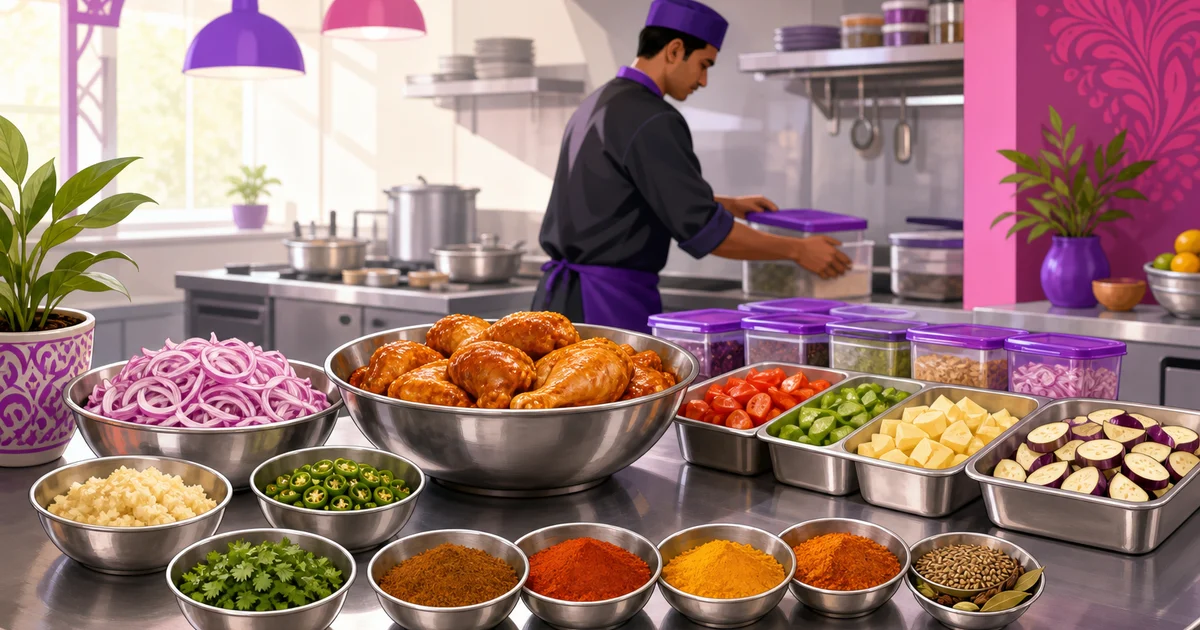
Mise en place is a French phrase that means "everything in its place", and in a kitchen it is the prep work done before service so a cook can make dishes quickly and consistently once orders start. That means onions chopped, ginger-garlic paste ready, chicken marinated, spices measured into small bowls, sauces simmered, and every tool and container set within reach. A line set up with good mise en place fires a biryani or a plate of kebab smoothly; a line without it falls behind the moment the first ticket lands. It is one of the oldest ideas in professional cooking and still the single biggest reason some kitchens stay calm under pressure while others scramble.
This guide explains what mise en place is, why it matters, how to build it practically in a working restaurant, and how it connects to prep production, food cost and waste. We use Rosuii as the running example where prep and stock come into it.
What is mise en place?
Mise en place (pronounced roughly "meez on plahss") is the practice of getting all your ingredients, tools and stations ready before you start cooking. The idea is that the moment a ticket arrives, the cook should not have to stop and chop an onion or hunt for a spoon. Everything is already prepped, portioned and positioned, so cooking becomes a fast sequence of assembling and finishing rather than starting from raw.
The phrase covers two things at once. First, the prepped ingredients themselves: washed, peeled, cut, measured and stored in labelled containers. Second, the physical setup of the station: pans, tools, oils, salt and bins arranged the same way every day so a cook can work without looking. Together they let a kitchen handle a rush, because the slow work was done in the quiet hours before guests arrived.
Mise en place as a mindset, not just a task
Experienced chefs talk about mise en place as a way of working, not only a checklist. It means thinking ahead, setting up before you need something, and keeping your space ordered as you go so the next step is always within reach. A cook with strong mise en place habits cleans as they work, refills containers before they run dry, and resets the station for the next service. The phrase has even spread beyond kitchens as shorthand for preparing properly before you begin any demanding task.
Why mise en place matters
The payoff shows up the moment service gets busy. Here is what good prep buys you.
Speed during the rush
When tickets pile up, the kitchen with everything prepped just assembles and cooks. The kitchen that still has to chop, measure and search loses seconds on every dish, and those seconds become long waits when twenty tickets are live. Mise en place is what lets a small team push out a Friday-night volume without the line collapsing. It directly affects how fast food reaches the pass and how quickly tables turn.
Consistency
When spices are measured in advance and portions are pre-cut, every plate of the same dish comes out the same. A guest who loved your beef bhuna last week gets the same dish this week, because the cook is not eyeballing quantities mid-rush. Consistency is what builds regulars, and mise en place is the quiet discipline behind it.
Less stress and fewer mistakes
A cook who is calm makes fewer errors. When the station is ordered and the prep is done, there is less reaching, less searching and less chance of grabbing the wrong container or forgetting a step. A chaotic station produces wrong dishes, which means remakes, comps and waste. Good mise en place lowers all of it.
How to set up mise en place in a restaurant
Building mise en place is a routine, repeated before every service. A practical version looks like this:
- Know what you will need. Look at what usually sells and prep to match. If Fridays do 150 covers and biryani is the top seller, you prep enough rice, marinated meat and garnish for that demand, not a random amount.
- Do the slow prep early. In the quiet hours, chop onions, make ginger-garlic paste, marinate proteins, cook base gravies, measure dry spices into bowls, and prepare anything that takes time.
- Portion and label. Store prepped items in clear, labelled containers with the date. Portioning into per-dish amounts speeds the line and controls how much goes into each plate.
- Set the station the same way every time. Oils, salt, tools and bins in fixed spots so any cook can work the station without relearning it.
- Top up and reset. During service, refill before things run out. After service, clean down and note what to prep more or less of next time.
The forecasting step at the top is where data helps. Knowing your real covers and which items sell, from your reports, tells you how much to prep so you are not guessing. Tie that to covers and your item-sales history and prep stops being a gut feeling.
Common mise en place mistakes
Most prep problems are not about effort; they are about a few habits that quietly cost time and food. The usual ones:
- Prepping by feel, not by demand. Cutting "about enough" onions without checking what last week actually sold leads to either a shortfall or a bin full of waste. Prep to your real numbers.
- No labels or dates. Unlabelled containers get used in the wrong order, so older prep spoils at the back while fresh prep gets used first. Label everything with the date.
- Setting up differently each day. If the salt and oils move around, every cook loses time relearning the station. Keep the layout fixed so the hands know where things are.
- Not resetting during service. Letting a container run bone dry mid-rush means stopping to refill at the worst moment. Top up before things run out, not after.
- Treating prep as one big job. Doing all prep in a single block and never adjusting means you cannot react to a busy day. Build a routine you repeat and tune every service.
Fixing these is less about working harder and more about a steadier routine. A cook who labels, preps to demand and resets as they go will out-perform one who simply prepares more.
Par levels: how much to prep
One useful idea from professional kitchens is the par level: the amount of each prepped item you want ready at the start of service. If experience says a busy Friday needs 8 kilos of marinated chicken and 6 litres of base gravy, those are your pars for Friday. Before service you prep up to par; during service you top back up toward it. Pars take the guesswork out of "how much" by turning it into a target you set from your own sales history and adjust as demand shifts. Set pars too low and you 86 dishes early; set them too high and you waste food and money. The right pars sit just above what you reliably sell, and they are easiest to set when you can actually see your covers and item sales rather than relying on memory.
Mise en place, productions and stock
In restaurant software, a lot of mise en place maps to the idea of making finished or semi-finished items ahead of service from raw ingredients. Cooking a big pot of biryani rice, a base curry gravy or a batch of marinade is exactly that: turning raw stock into ready-to-use prep. Recording these as productions keeps your stock honest, because the raw ingredients come out of inventory and the prepped item is tracked as something you made.
This is also where mise en place meets your numbers. Over-prepping is waste: food prepped that does not sell gets thrown out, which hurts both your food cost percentage and your bottom line. Under-prepping means you 86 popular dishes early and lose sales. Good mise en place is prepping the right amount, and the way to find the right amount is to look at what you actually sold. Tracking prep against sales is one of the most practical ways to reduce food wastage.
How Rosuii supports your prep
Rosuii does not cook for you, but it gives you the information and the records that good mise en place depends on. The inventory module holds your raw stock items with units, costs and low-stock alerts, so you know what you have to prep with. When you make a batch of something ahead of service, you can record it as a production: raw materials are consumed and the finished item is logged, so your stock reflects reality instead of guesswork.
The forecasting side comes from your reports. Item-sales and sales reports over a date range show which dishes move and how busy each day and hour tend to be, so you can prep to demand rather than habit. If biryani sells out by nine every Friday, that is a clear signal to prep more rice and marinated meat. Wastage records let you log spoilage with a reason, so over time you can see whether you are consistently prepping more than you sell.
Put together, that means your mise en place is driven by what your restaurant actually does, not a guess. You prep the right quantities, your stock numbers stay accurate because productions and wastage are recorded, and your food cost stays under control. For how inventory and prep sit inside the wider platform, read our guide to the restaurant POS system.
Want your prep planned from real covers and sales, with stock that updates as you produce and waste? Create your free Rosuii account and set up your inventory, productions and reports.
Updated:
Frequently asked questions
What does mise en place mean?
Why is mise en place important in a restaurant?
How do you set up mise en place?
How does mise en place affect food cost?
How does Rosuii help with kitchen prep?
Run your restaurant on Rosuii
POS, menu, inventory, payroll and more — built for Bangladeshi restaurants.
Start free