Restaurant Inventory Software: A Practical Buyer's Guide
Restaurant inventory software should tell you what is in stock, what was purchased, what was wasted and what needs ordering. This guide shows the capabilities to test before you buy.
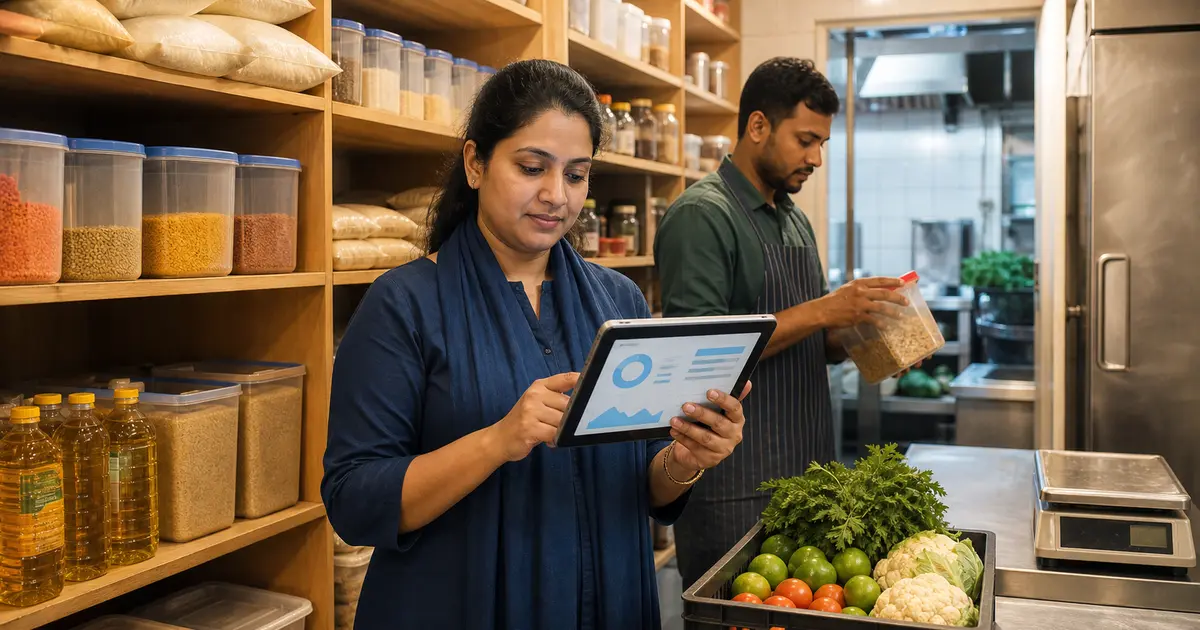
Restaurant inventory software records the ingredients, packaging and supplies your restaurant owns, where they are kept, what they cost and when they need replenishing. A useful system replaces the stock notebook with a repeatable process for receiving, counting, purchasing and recording waste.
The buying mistake is choosing from a long feature list without testing the daily stock workflow. Your manager should be able to receive a delivery, move stock to the correct branch, record spoilage and see a low-stock item without building another spreadsheet.
This guide focuses on software selection. For the counting routine itself, see the related restaurant inventory management guide below.
What restaurant inventory software should control
A restaurant stock system starts with a clean item catalogue. Each item needs a name, unit, cost, supplier and minimum level. Branch stock must stay separate so ten kilograms of rice in Uttara is not mistaken for stock in Dhanmondi.
The system should connect four jobs: receiving purchases, keeping current quantities, recording production or wastage, and giving the owner reports that explain changes. If one job still lives in a notebook, the number on the dashboard will drift.
- Stock items with SKU, unit, cost and minimum-stock level
- Per-branch quantities and a clear receiving workflow
- Supplier records and purchase orders with approval and payment status
- Production records for turning raw materials into finished goods
- Wastage records with quantity, cost and reason
- Count and movement history that a manager can review
Inventory software versus a spreadsheet
A spreadsheet can work for one small stockroom if one disciplined person updates it. Problems start when purchases, transfers and wastage happen during different shifts. Two people edit separate copies, units are inconsistent, and the owner sees yesterday's number as if it were current.
Software adds permissions, branch separation and a shared record. It does not fix weak habits on its own. Staff still need to receive every purchase and count on a schedule. The advantage is that missing steps become visible instead of disappearing inside a formula.
The demo tests that expose weak systems
Bring three real items to the demo: one bought by kilogram, one bought by piece and one packaging item. Ask the vendor to create them, receive a purchase and record partial wastage. Then change branches and check whether the quantities remain separate.
Do not accept a dashboard tour. A ten-minute transaction test reveals whether the software fits kitchen reality.
- Can one item use the unit your supplier actually invoices?
- Can the purchase order be approved, received and marked paid separately?
- Can staff record spoilage with a reason without changing stock by hand?
- Can the owner see low stock by branch?
- Can you export a clean stock or purchasing report?
- Can permissions stop a cashier from editing inventory cost?
Be precise about recipes and automatic deduction
Recipe deduction and a production batch are different workflows. Rosuii supports optional ingredient recipes for each menu item and size. The owner enables deduction in Settings → Cost of Goods; when a configured item is ordered, its ingredient quantities are deducted. Cancelling the order credits its recorded quantities back.
Enter recipe quantities in the inventory item’s own unit. There is no automatic kg-to-g conversion, sub-recipe, yield factor or theoretical-versus-actual variance report. Recipe cost is an estimate from the current inventory unit cost, not weighted-average valuation or a historical food-cost study.
Stock uses a shared pool by default. Settings → Outlets can enable separate outlet balances; establish and check opening stock before relying on recipe deductions. Treat a software cancellation credit separately from the kitchen decision about prepared food: do not assume food is physically reusable.
A recipe-unit test before your first service
Hypothetical example: opening raw chicken stock is 10 kg. A sample burger recipe uses 0.150 kg of that ingredient. With recipe deduction enabled, twenty orders should consume 20 × 0.150 = 3 kg, leaving 7 kg if no purchases, waste, transfers or other orders occurred. These quantities are chosen for arithmetic; they are not Rosuii recipe recommendations or measured restaurant results.
If the ingredient is stored in kg, entering 150 would mean 150 kg, not 150 g. Check one controlled test order and its stock ledger before loading all recipes. If the kitchen physically counts 6.8 kg instead of 7 kg at the same cut-off, the manual difference is 0.2 kg. Investigate records and portion use; this comparison is not an automated Rosuii variance report.
What Bangladesh restaurants should check
Local purchasing often mixes formal supplier invoices, cash market purchases and different pack sizes. The software must let the team use practical units and record costs in BDT without forcing an overseas purchasing model.
Also test Bangla labels for staff, browser access on affordable devices, and how the system behaves when the internet drops. Inventory reports need a connection in Rosuii, while the POS can queue cash orders offline after device data has been synced.
Dedicated inventory tool or all-in-one platform?
A dedicated food-cost tool may be the better choice when recipe costing, theoretical usage and complex central-kitchen production are non-negotiable. An all-in-one restaurant platform is usually easier when the main goal is to keep purchases, branch stock, waste, POS and expenses in one operating record.
Choose by the handoffs you want to remove. If staff must export POS sales and rebuild them inside another stock tool, include that labour and error risk in the price comparison. If you choose one platform, confirm that its inventory depth covers your actual workflow rather than assuming every module is equally detailed.
- List the three inventory decisions your manager makes every week
- Run one purchase, one production and one wastage entry in the demo
- Compare total monthly cost, training time and duplicate data entry
- Pilot one branch and twenty high-value items before a full rollout
Where Rosuii fits
Rosuii includes inventory and purchasing from Starter at ৳500 per month in the catalog verified 2026-09-11. It records stock, minimum levels, suppliers, purchase orders, production and wastage. Optional per-outlet balances require configuration. Inter-outlet transfer documents record draft, sent, received and cancelled stages; sending and receiving post separate stock movements.
That fit is strongest for an owner who wants operational stock control without buying a separate inventory subscription. Start with a small item catalogue, test the receiving and wastage flow, then expand once staff use the process consistently.
Run a controlled count-and-variance cycle
Define item name, unit, conversion, branch location and count owner before relying on a stock total. Freeze or clearly record movement during the count, use a second check for material differences and compare physical quantity with the system as of the same time. A variance without a cut-off can be caused by a late receipt or sale rather than loss.
Classify the reason before editing the balance: receiving difference, unit conversion, transfer, production yield, portioning, wastage, unrecorded use or count error. Require a reference and approver for adjustments. Review recurring causes, then correct purchasing, receiving, recipe, transfer or training instead of repeatedly forcing the number to match.
How we calculated and verified this
Rosuii publishes this guide as a software vendor. Product statements were checked against the current repository and public feature pages on 2026-10-01; this is not an independent vendor ranking or a customer field study. Pricing uses the published catalog verified 2026-09-11. Worked examples are hypothetical and exclude any costs not explicitly listed.
Choose restaurant inventory software by running a real stock transaction, not by counting feature checkboxes. The system should make purchases, quantities, waste and branch responsibility easier to verify every day.
If recipe-level automatic deduction is essential, verify it explicitly. If your priority is practical stock, supplier and purchasing control connected to the restaurant POS, test Rosuii with your own ingredients.
Related guides
- Restaurant Inventory Management: A Practical Guide
- POS Software With Inventory Management
- Restaurant Purchase Orders and Supplier Management
See this workflow in Rosuii: See Rosuii inventory and purchasing features
Last updated:
Frequently asked questions
What is restaurant inventory software?
What features should restaurant inventory software include?
Can restaurant inventory software reduce food waste?
Can Rosuii deduct recipe ingredients automatically?
How much does restaurant inventory software cost in Bangladesh?
Run your restaurant on Rosuii
POS, menu, inventory, payroll and more — built for Bangladeshi restaurants.
Start free